Restaurant lighting mistakes are among the most expensive errors hospitality owners make in Thailand — yet they are almost never identified as the actual cause of the problems they create. Owners will spend weeks choosing the right chairs, the right tiles, the right menu, then hand the lighting design to an electrician who installs whatever fixtures are in the catalog. The result is a space that looks flat, feels off, and quietly drives guests away without anyone understanding why.
Lighting is not just illumination. It shapes how people feel in a space, controls where they look, determines how long they stay, and influences whether they take photos and share them online. Good lighting is invisible — guests notice the food, the service, the atmosphere, but never the light itself. Bad lighting is the first thing everyone notices, even when they cannot articulate what is wrong.
After designing lighting systems for venues across Phuket, Pattaya, Krabi, and the southern islands, we have identified five restaurant lighting mistakes that appear in nearly every project we are called in to fix. Each one is preventable with proper design at the planning stage — and each one becomes exponentially more expensive to correct after construction is complete.
The Obvious Lighting Mistakes Every Thailand Venue Owner Has Already Heard About
Before we get to the five restaurant lighting mistakes that quietly destroy venues, it is worth acknowledging the basics every lighting guide repeats: too bright kills atmosphere, too dim makes menus unreadable, and unlit exteriors lose walk-in traffic before guests even reach the door. These are real issues, and any competent lighting designer addresses them by default. They are also the only lighting topics most owners consider before opening a venue.
The five restaurant lighting mistakes below are different. They are the errors that survive a careful design process, that pass owner walk-throughs at handover, and that only reveal themselves months later when bookings start sliding for reasons no one can name. They are the mistakes that separate venues that thrive from venues that struggle.
Mistake 1: One Switch, One Mood — The Single-Scene Venue Across Thailand
Most venues operate with a single lighting state: everything on, or everything off. But a restaurant at 6pm lunch service and the same restaurant at 10pm on a Saturday night are two completely different commercial experiences. They need two completely different lighting scenes — yet most installations physically cannot deliver them.
This is one of the most common restaurant lighting mistakes we encounter. The wiring runs everything to one circuit, the dimmers (if installed at all) control the entire room as a single zone, and the staff has no practical way to shift the atmosphere across a service. Lunch ends up feeling like dinner; dinner feels like a brightly lit cafeteria; late-night drinks happen under fluorescent overhead light because that is the only setting available.
The Fix: Zoned Dimming with Preset Scenes for Thai Venues
Separate the venue into logical zones — bar area, dining floor, entrance, feature wall, restrooms, service stations — and program multiple scenes that shift throughout the operating day. Lunch becomes bright and clean to support productive midday meetings. Dinner shifts to warm and intimate to encourage longer stays and higher per-table spend. Late evening becomes moody and dramatic to support drinking and conversation. One tap on a wall controller, not fifteen minutes of adjusting individual switches by trial and error.
Modern DMX or proprietary control systems make fixing this category of restaurant lighting mistakes affordable even for smaller venues. The infrastructure cost is modest if installed during construction — typically adding only THB 80,000–180,000 to a small-venue lighting line item. Retrofitting zoned control into a finished venue typically costs three to five times more, because walls and ceilings must be opened to add new wiring runs.
Mistake 2: Overhead-Only Lighting — The Flat-Light Trap in Phuket & Koh Samui Venues
Downlights mounted in the ceiling are the default lighting choice in most commercial venues across Thailand — and they are usually the worst possible choice when used as the only light source. Straight-down light from above creates harsh shadows on faces, makes food look flat and unappetizing, and turns every guest into a raccoon-eyed version of themselves. Yet thousands of restaurants and bars across Phuket, and Pattaya operate exclusively under overhead downlights, baffled when guests rate the atmosphere poorly despite excellent food and service.
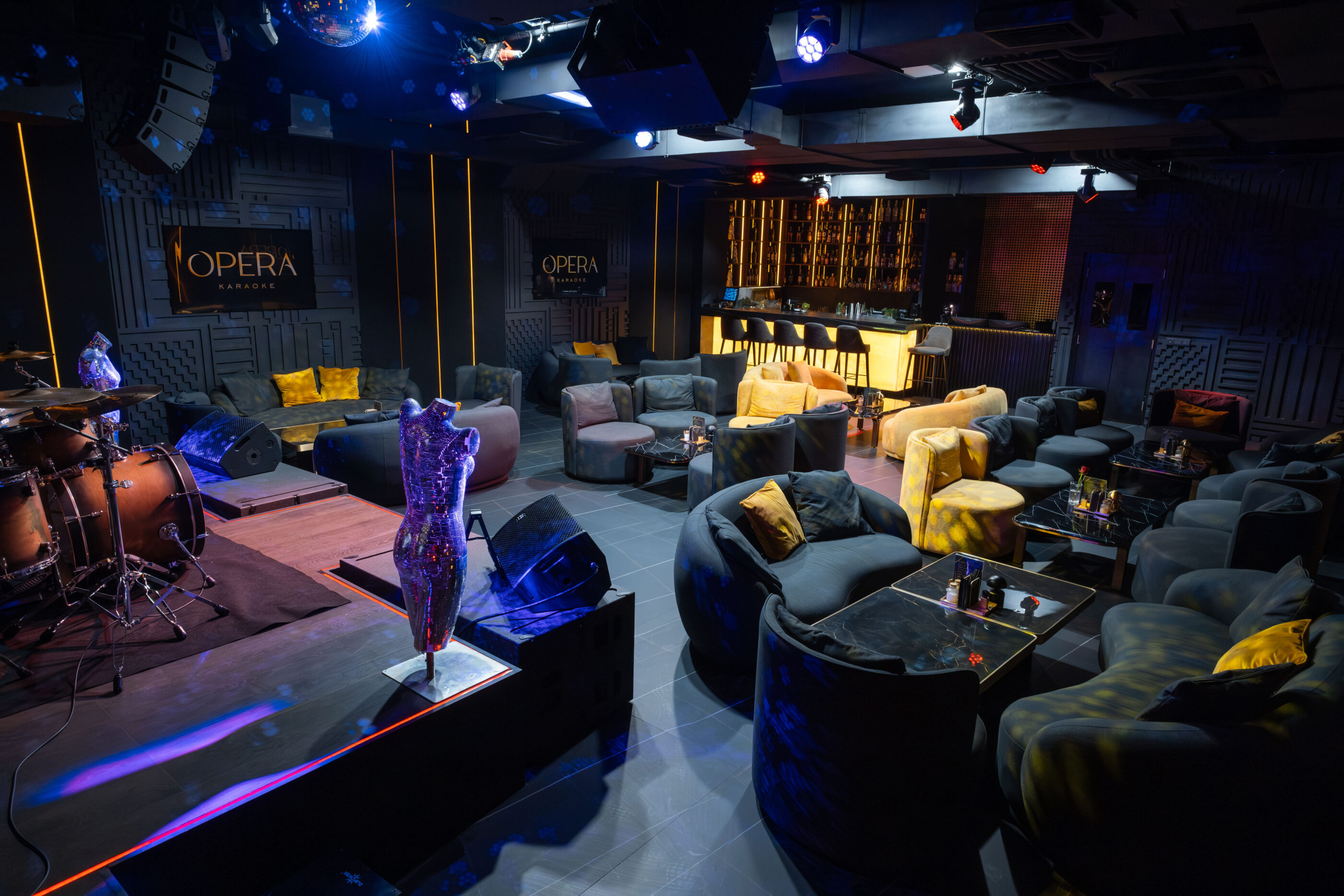
This ranks high on our list of recurring restaurant lighting mistakes precisely because it seems so basic. Owners assume that ceiling fixtures are the standard solution because every contractor installs them by default — but defaults exist because they are cheap to install, not because they create the right environment for hospitality.
The Fix: Layered Lighting for Thailand Hospitality Venues
Professional venue design uses at least three layers working together: ambient lighting (general fill that establishes overall brightness), accent lighting (highlighting features, art, textures, architectural elements), and task lighting (focused light at bar tops, service stations, menu displays, host stands). The overhead downlights become just one element of a much richer composition rather than carrying the entire visual load.
Wall sconces and table lamps add warmth at eye level. LED strips behind shelving or under bar overhangs create depth and visual interest. Track lighting on adjustable heads accents focal points like the entrance arrangement or signature artwork. Linear pendant fixtures over communal tables create intimate pools of light that feel inviting without being stark. Together, these layers transform a flat space into a three-dimensional environment that photographs beautifully and feels welcoming to guests. For deeper technical context that complements this guide to restaurant lighting mistakes, see our professional lighting installation guide for Thailand venues.
Mistake 3: Wrong Color Temperature — The Silent Killer of Ambiance in Thai Restaurants
Color temperature — measured in Kelvin (K) — is the silent killer of venue ambiance and the third entry on our list of costly restaurant lighting mistakes. Cool white light at 5000K and above makes a lounge feel like a hospital waiting room. Warm white at 2700K in a corporate event space makes it feel like someone’s living room. Neither setting is inherently wrong — they are simply wrong for those particular contexts. Yet color temperature is one of the most overlooked factors in lighting specification, leading to spaces that fail to deliver their intended emotional register.
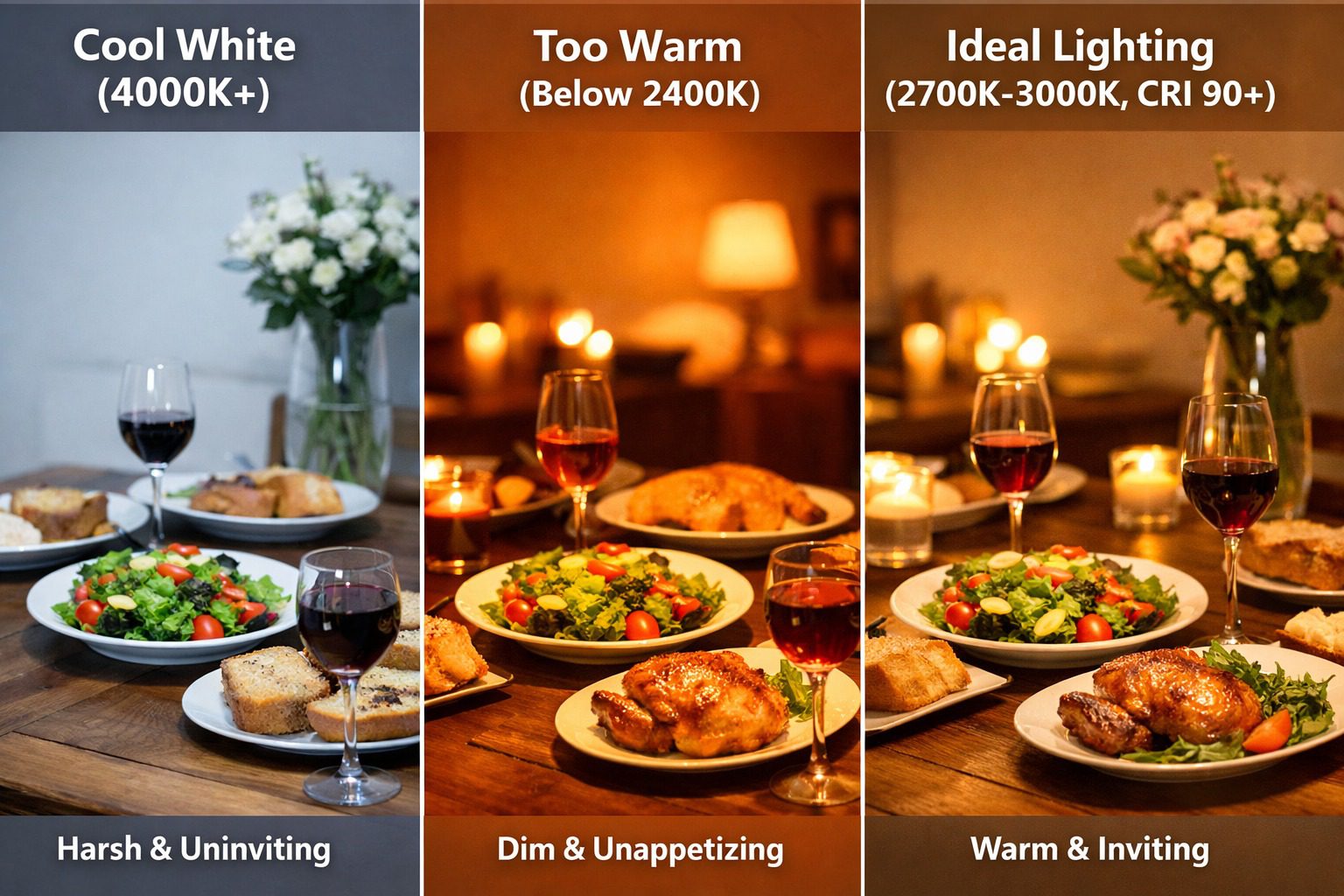
Among the restaurant lighting mistakes that affect food perception specifically, wrong color temperature is the worst offender. Skin tones look unhealthy under cool light. Cooked meat looks gray. Vegetables look limp. Wine looks dull. The same dish that photographed beautifully on the menu under warm tungsten lighting in the food stylist’s studio appears washed out on the customer’s plate under 4000K downlights.
The Fix: Match Color Temperature to Venue Purpose Across Thailand
| Venue Type |
Recommended Color Temperature |
Why |
| Restaurants & lounges |
2200K–2700K |
Warm, flattering; food and skin look great |
| Cocktail bars & speakeasies |
2000K–2400K |
Deep amber, intimate, dramatic |
| Hotel public spaces |
2700K–3000K |
Balance of warmth and practical visibility |
| Conference & meeting rooms |
3500K–4000K |
Neutral, focused, no eye fatigue |
| Nightclubs / event spaces |
Tunable white + RGBW |
Shifts from corporate 3000K to full color for parties |
| Beach clubs (day & night) |
Tunable 2700K–4000K |
Adapts from daytime brightness to evening warmth |
Equally important: every fixture in a given zone should have the same color temperature. Mixing 3000K and 4000K fixtures in the same room produces a visually jarring result that even untrained guests notice as “something off about the lighting,” even if they cannot pinpoint why. This is one of the most common restaurant lighting mistakes when projects use mixed-source fixtures from different vendors.
Equally critical is Color Rendering Index (CRI). A fixture rated CRI 80 will render food and skin tones noticeably worse than a CRI 90+ fixture, even at identical color temperature. The Illuminating Engineering Society (IES) recommends CRI 90+ for hospitality applications where food appearance and customer comfort are priorities. For hospitality applications, specify CRI 90 minimum — CRI 95+ for premium venues where food presentation is central to the concept. The cost difference per fixture is small; the impact on guest perception is substantial.
Mistake 4: Ignoring the “Instagram Test” — Lighting That Loses Free Marketing for Phuket / Koh Samui Venues
Whether owners like it or not, guests are photographing venues every night and posting those photos to social media. In tourist-driven markets like Phuket, Samui, Phangan, Krabi, and Pattaya, that social-media stream often carries more booking influence than the venue’s own marketing. This is free marketing of enormous value — or significant damage — depending entirely on whether the lighting design supports flattering photography or works against it. Bad lighting does not just affect the in-person experience; it affects every Instagram and TikTok post that emerges from the venue, shaping how thousands of potential guests perceive the place before they ever visit.
If guests cannot take a flattering photo of themselves or their food in your venue, they typically will not post. And when they do post under poor lighting conditions — grainy, color-shifted, harsh-shadowed images — the resulting content actively damages the venue’s social media presence. This makes ignoring photographic considerations one of the most commercially damaging restaurant lighting mistakes in the modern hospitality landscape.
The Fix: Engineered Photo Zones for Thailand Restaurants & Bars
Intentionally design two or three “photo zones” within the venue with carefully considered lighting. A feature wall with a wash of warm light becomes a natural backdrop for selfies. A bar area with dramatic backlighting on bottles creates a striking foreground for cocktail photos. A corner booth with soft overhead glow flatters faces and food alike. These zones become organic content generators — guests do free marketing for the venue, and the resulting photos look professional rather than amateur.
Practical considerations for photo-friendly lighting include high-CRI fixtures of 90+ that render colors accurately, avoiding the green or magenta tints that ruin food photography. Eye-level light sources — wall sconces, table lamps, candles — produce far more flattering results than downlights, which create heavy shadows under brows and noses. And consistent color temperature across the photo zone prevents the multi-cast appearance that no amount of editing can fully fix.
Mistake 5: Treating Lighting as a One-Time Purchase — The Trap Catching Thai Venues at Year Two
Venues evolve. The menu changes. The concept shifts. A new private dining area opens up. Seasonal events require different atmospheres. The original concept that drove design decisions on opening night gradually transforms into something different over the venue’s operational life — but the lighting infrastructure typically remains exactly as it was on day one. This is the fifth and most insidious of the restaurant lighting mistakes we identify in our audit work.
Within a year or two, the lighting design no longer matches the space it serves. Owners notice that the venue “feels different” or “has lost something” — but they rarely connect this feeling to the lighting. They assume the problem is staff turnover, menu fatigue, or competitive pressure, when in fact the visual environment has simply drifted out of sync with current operations.
The Fix: Reprogrammable Lighting Infrastructure for Long-Lifecycle Thai Venues
Install a lighting system that can be reprogrammed rather than just replaced. DMX-controlled fixtures, a programmable lighting controller, and documented scene presets allow the venue to adapt its lighting design as operations evolve — without rewiring, without buying new hardware, and without major construction. New scenes can be programmed to support seasonal events, special occasions, private hire configurations, or concept refreshes. This kind of flexibility is what separates lighting installations that age well from those that become obsolete.
The DMX512 protocol is the industry standard for this kind of programmable control. Reference documentation is maintained by the United States Institute for Theatre Technology (USITT), the body that maintains the DMX standard. Any lighting controller you specify should be DMX-native, not a proprietary system that locks you into a single vendor.
Case Study: Mirage Indigo — Rooftop Restaurant in Phuket
One of our reference projects illustrating how to avoid the common restaurant lighting mistakes outlined above is the Mirage Indigo rooftop restaurant in Phuket, where Clubtek delivered an integrated lighting and audio environment designed for the venue’s extended day-to-night operation cycle.
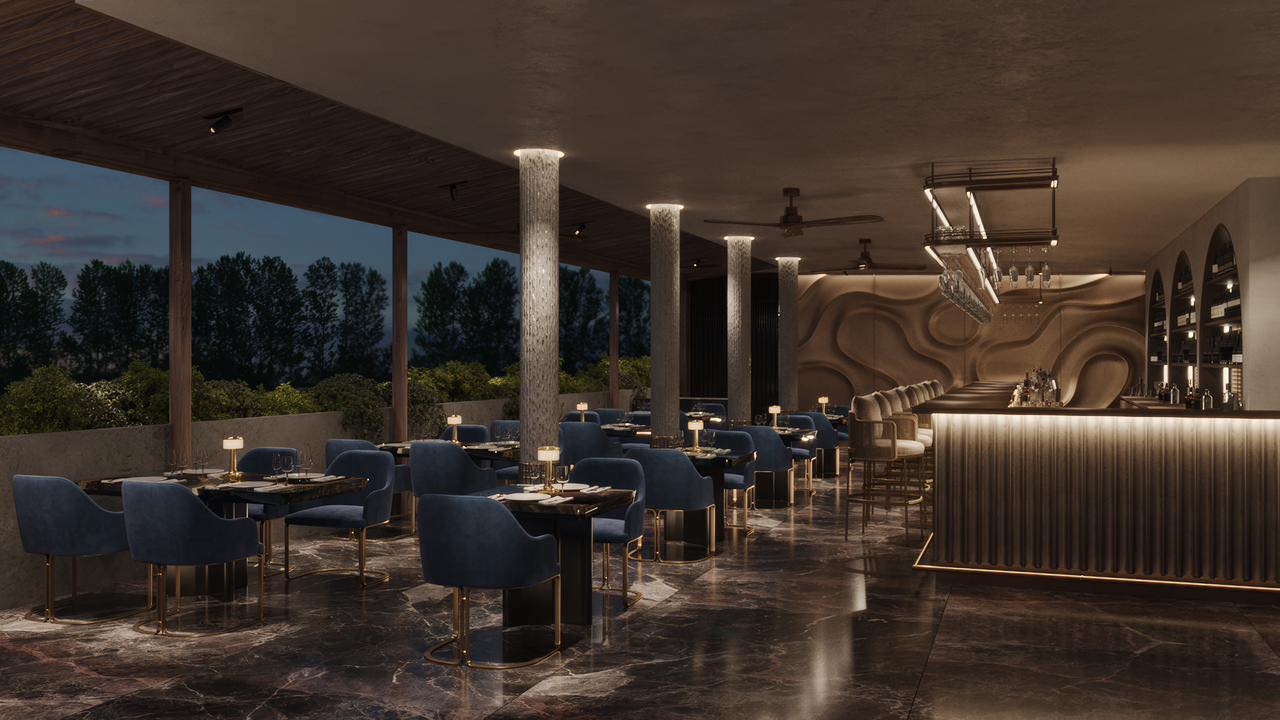
Challenge: The venue operates from afternoon through late evening, requiring lighting that adapts seamlessly from daytime food service to sunset ambiance to late-night cocktail-bar atmosphere — all while supporting Instagram-friendly photography across every operational mode.
Solution: Tunable white fixtures (2700K–4000K) handle the daytime-to-evening color temperature shift automatically via DMX scene programming. Dedicated photo-zone lighting on the bar back-wall and feature seating areas uses CRI 95+ fixtures with eye-level wall washes. Architectural accent lighting was layered over functional ambient lighting, with each zone independently dimmable and grouped into scene presets accessible via wall controller and tablet interface. The system is fully reprogrammable to support seasonal menu refreshes and special events.
Result: Consistent, flattering atmosphere across an 8-hour service window with one-tap scene transitions, reliably photogenic photo zones generating organic social-media content, and an infrastructure that has accommodated three concept refreshes without hardware changes — a working example of how thoughtful design eliminates the restaurant lighting mistakes that plague most installations.
Thailand-Specific Lighting Considerations for Pattaya, Phuket & Coastal Venues
Beyond the universal restaurant lighting mistakes outlined above, Thai venues face additional environmental challenges that international design guides typically ignore. Outdoor and semi-outdoor installations — rooftop bars, beach clubs, covered terraces — require IP65-rated fixtures minimum, with marine-grade stainless steel mounting hardware in coastal locations. Standard interior fixtures installed in these environments typically fail within 12–18 months as humidity, salt air, and rain attack the electronics.
Heat is another factor. Thailand’s ambient temperatures stress LED drivers and reduce fixture lifespan compared to performance ratings developed in cooler climates. Quality fixtures with proper thermal management deliver their rated lifespans; cheaper fixtures may lose 30–40% of their expected lifetime due to chronic heat stress.
Power quality issues common to Thai electrical infrastructure also damage sensitive lighting electronics over time, making surge protection and line conditioning standard requirements rather than optional add-ons. For coastal projects in Phuket, Koh Samui, and Koh Phangan, marine-rated hardware should extend not just to luminaires but to junction boxes, conduit, and connector terminations.
These factors do not change which lighting design principles apply — layered lighting, zoned control, correct color temperature, photo-friendly considerations, and adaptable systems remain universal. They do change which specific products and installation methods deliver those principles reliably in Thailand’s tropical conditions, and which restaurant lighting mistakes are most likely to surface as a result of climate stress.
The Bigger Picture: Lighting as Infrastructure for Thailand’s Hospitality Industry
All five of these restaurant lighting mistakes share the same root cause: treating lighting as decoration rather than as infrastructure. Decoration is something you add at the end of a project to make a space look nice. Infrastructure is something you design from the beginning because it determines how the space functions. Lighting belongs firmly in the infrastructure category — it shapes everything from guest experience to staff productivity to social media presence to operational flexibility.
Avoiding the most common restaurant lighting mistakes is not about buying expensive fixtures. It is about designing an integrated system that serves the space, the guests, and the business at every stage of operation. The cost difference between thoughtful design and default specification is usually 15–25% on the lighting line item — a tiny fraction of total project cost — yet the impact on long-term venue success is enormous.
Owners planning new venues should bring lighting designers into the project at the architectural planning stage, not after construction is complete. Owners with existing venues experiencing inexplicable customer drop-off should commission a lighting audit before assuming the problem lies elsewhere. In both cases, addressing the underlying restaurant lighting mistakes pays back through better guest retention, stronger social media presence, and a venue atmosphere that supports the business goals it was built to serve.
Restaurant & Bar Lighting Projects Across Thailand
Clubtek delivers restaurant and bar lighting design across every major Thai hospitality market, helping owners avoid the restaurant lighting mistakes outlined in this guide. Phuket‘s restaurant scene — from Patong waterfront cocktail bars to Cherngtalay and Bangtao fine-dining rooms to Kata and Kamala beachfront restaurants — demands lighting that handles tropical conditions, high turnover, salt air, and Instagram-driven discovery. Pattaya entertainment-district venues prioritize dramatic, brand-defining lighting. Koh Samui and Koh Phangan beach clubs and villa restaurants need IP65-rated fixtures, marine-grade hardware, and tunable systems that adapt from sunset service to late-night operation.
Each market changes which fixtures, control systems, and installation methods deliver the design principles outlined above. The five restaurant lighting mistakes are universal across Thailand — but the right fix in Phuket is rarely the right fix in Samui, and the right fix in Samui is rarely the right fix in Phangan.
Frequently Asked Questions: Restaurant Lighting Mistakes & Design in Thailand
What are the most common restaurant lighting mistakes in Thailand venues?
The five most costly restaurant lighting mistakes we see across Phuket, Samui, Phangan, Krabi, and Pattaya are: single-scene operation (no zoned dimming), overhead-only fixtures (no layered lighting), wrong color temperature, ignoring photographic considerations, and treating lighting as a one-time purchase rather than reprogrammable infrastructure. Each is preventable at the design stage and exponentially more expensive to fix after construction.
What color temperature is best for a restaurant in Thailand?
For most restaurants and lounges in Phuket, Samui, Phangan, Krabi, and other Thai markets, 2200K–2700K delivers warm, flattering light that makes food and skin tones look great. Cocktail bars and speakeasies benefit from even warmer 2000K–2400K. Conference and meeting rooms perform best at 3500K–4000K. The key rule: every fixture in a given zone should share the same color temperature, and CRI should be 90+ for hospitality applications.
How many lighting zones does a small Phuket, Samui, or Krabi restaurant need?
Even a small Phuket restaurant typically benefits from at least four to six independently controllable lighting zones: bar area, dining floor, entrance, feature wall or art display, restrooms, and service stations. Each zone should be programmable into scene presets for lunch, dinner, late evening, and private events.
Is it cheaper to fix restaurant lighting mistakes before or after construction?
Dramatically cheaper before. Adding zoned dimming and DMX control during construction typically costs THB 80,000–180,000 for a small Phuket venue. Retrofitting the same capability into a finished venue typically costs three to five times more, because walls and ceilings must be opened to add wiring runs.
What CRI should restaurant lighting have?
Specify CRI 90 minimum for hospitality applications. CRI 95+ is recommended for premium venues where food presentation is central to the concept. Below CRI 80 (the legal minimum for many jurisdictions), food and skin tones render visibly poorly and photographs come out color-shifted — one of the most damaging restaurant lighting mistakes for social-media-driven venues.
Do I need DMX control for a small bar?
Not necessarily — but if you want zoned scenes, future programmability, and integration with other AV systems (audio, video, automation), DMX is the industry-standard protocol that makes those capabilities possible. Even a small venue benefits from a basic DMX backbone installed during construction; adding it later costs three to five times more.
How long do quality LED lighting fixtures last in Thailand’s climate?
Quality fixtures with proper thermal management deliver their rated lifespans (typically 30,000–50,000 hours). Cheap fixtures may lose 30–40% of their expected lifetime due to chronic heat stress in Thai conditions. Outdoor and semi-outdoor installations in coastal Phuket, Samui, Phangan, Krabi, and Pattaya require IP65-rated fixtures with marine-grade hardware.
Where does Clubtek deliver restaurant and bar lighting design in Thailand?
Clubtek delivers restaurant and bar lighting projects across Phuket, Koh Samui, Koh Phangan, Krabi, and Pattaya — from urban shophouse conversions to coastal resorts and rooftop bars. Each market has different environmental and operational requirements that shape which fixtures, controls, and installation methods are appropriate for avoiding the restaurant lighting mistakes outlined in this guide.
Ready to Avoid These Restaurant Lighting Mistakes in Phuket or the Islands?
The five restaurant lighting mistakes outlined here — single-mood operation, overhead-only fixtures, wrong color temperature, ignoring photographic considerations, and treating lighting as a one-time purchase — account for the vast majority of lighting-related problems we see across Thailand’s hospitality industry. Each one is fully preventable with proper planning and the right contractor. None can be cheaply fixed after construction.
When evaluating contractors for a lighting project, ask specific questions about their design methodology. How do they approach zoning? What color temperatures do they recommend for your specific concept, and why? How do they account for photographic considerations? What kind of control system will allow future adaptation? Vague answers indicate an installer rather than a designer — someone who will mount fixtures rather than create an atmosphere, and who will leave you living with the same restaurant lighting mistakes you came to them to avoid.
At Clubtek, lighting design is part of every project from day one, integrated with sound, video, and control systems to create unified environments where every element works together. Our engineering team designs lighting installations matched to each venue’s operational requirements, aesthetic goals, and budget reality — from intimate restaurants and lounges to high-energy nightclub installations and rooftop restaurants.
We provide lighting audits for existing venues, design services for new construction, fixture specification, DMX programming, installation, and ongoing technical support across Phuket, Koh Samui, Koh Phangan, Krabi, and Pattaya.
Contact Clubtek Thailand for a professional lighting consultation:
Lighting works best when integrated with sound and other AV systems. See our nightclub sound system installation guide for venues that combine high-energy lighting with audio, our beach club coastal audio guide for outdoor lighting + sound integration, and our rooftop bar audio guide. For DMX scene control and full automation, visit Clubtek smart AV automation.