Creating concert-grade audio experiences for Thailand’s nightlife venues
Introduction
Step into Phuket’s top nightclubs and the first thing that hits you isn’t the lights or the crowd—it’s the sound. Deep, powerful bass you feel in your chest. Crystal-clear highs cutting through packed dancefloors. Music so immersive that guests lose themselves for hours. This sonic experience doesn’t happen by accident. It requires concert-grade audio systems, expert acoustic design, and installation precision that separates world-class venues from amateur operations. (See: acoustic treatment engineering guide for Thai nightclubs.)
…nightclub sound system Thailand installations require…
Nightclub audio represents the highest tier of commercial sound installation. Unlike restaurants where background music supports conversation, nightclub sound system Thailand installations require audio as the primary experience. Sound systems must deliver club-shaking bass, maintain clarity at extreme volumes, operate reliably through 8-12 hour sessions, and handle the physical punishment of nightly operation. The investment is substantial—quality nightclub systems start at several million baht—but the return justifies the cost. Superior sound quality directly drives guest satisfaction, social media buzz, and competitive advantage in Thailand’s intensely competitive nightlife market.
This guide covers everything venue operators need to know about professional nightclub audio installation—from understanding technical requirements unique to club environments, to selecting appropriate equipment tiers, to avoiding costly mistakes that plague amateur installations.
Why Nightclub Audio is Different
Concert-Grade Performance Requirements
Nightclub audio systems face demands no other commercial installation encounters. Sound pressure levels reach 100-110 dB—comparable to live concerts—sustained for entire operating sessions. This extreme output requires components built for professional touring: high-power amplifiers running cool under sustained load, speaker drivers handling continuous punishment without distortion, and DSP systems preventing damage while maintaining sonic quality.
Frequency response requirements extend far beyond typical commercial audio. Deep bass extension down to 30-40 Hz creates the physical impact guests expect from electronic music. Extended high-frequency response (up to 18-20 kHz) delivers the air and detail separating professional systems from consumer gear. Mid-range clarity remains critical—vocals and melodic elements must cut through dense mixes without harshness or fatigue.
Dynamic range capabilities distinguish professional nightclub systems. Music transitions from quiet breakdowns to explosive drops demand instantaneous response without compression artifacts or distortion. Quality systems maintain composure across this 40+ dB dynamic range, while inadequate installations compress dynamics, flatten impact, and sound amateurish.
Physical Durability for Nightly Operation
Nightclub equipment operates under punishing conditions. Amplifiers run at high output for 6-8 hours nightly, generating significant heat. Speakers endure continuous excursion at maximum rated power. Connections face constant vibration. This demanding environment exposes any weakness in component quality or installation workmanship.
Professional-grade equipment includes protection features absent from consumer products: thermal monitoring shutting down amplifiers before damage occurs, speaker limiters preventing driver failure, fault detection alerting staff to developing problems. These features aren’t luxury options—they’re essential reliability measures preventing mid-session failures that devastate guest experience and venue reputation.
Thailand’s climate adds environmental challenges. Humidity attacks electronics and speaker components. Dust accumulation degrades performance and blocks cooling. Salt air (for coastal venues) accelerates corrosion. Professional installations specify components rated for these conditions and include maintenance schedules addressing environmental degradation.
Integration with DJ Equipment and Lighting
Nightclub audio systems don’t operate in isolation. Integration with DJ equipment requires proper signal routing, gain staging, and monitoring. DJs need accurate booth monitors allowing precise mixing without reference to main speakers. Dedicated DJ inputs with appropriate level matching prevent gain structure problems causing distortion or inadequate output.
Lighting synchronization creates cohesive sensory experiences. Modern systems support DMX integration allowing lighting to respond to music dynamics. Audio triggers fire lighting cues matching drops, buildups, and transitions. This integration requires planning during system design—retrofit installations face significant complexity and cost.
Technical Requirements for Nightclub Sound System Thailand Installations
Line Array Systems
Professional nightclub installations increasingly utilize line array speakers—multiple identical enclosures arrayed vertically and aimed to cover specific audience areas. Line arrays deliver critical advantages over traditional point-source systems: even coverage across large spaces, controlled vertical dispersion reducing ceiling reflections and preventing energy waste, and consistent tonal balance from front to back of venue.
Line array physics create coherent wavefronts maintaining definition and impact over distance. Traditional speaker arrangements create interference patterns and uneven coverage—some areas receive too much sound, others too little. Line arrays solve this through precise aiming and electronic delay alignment, creating uniform coverage impossible with conventional approaches.
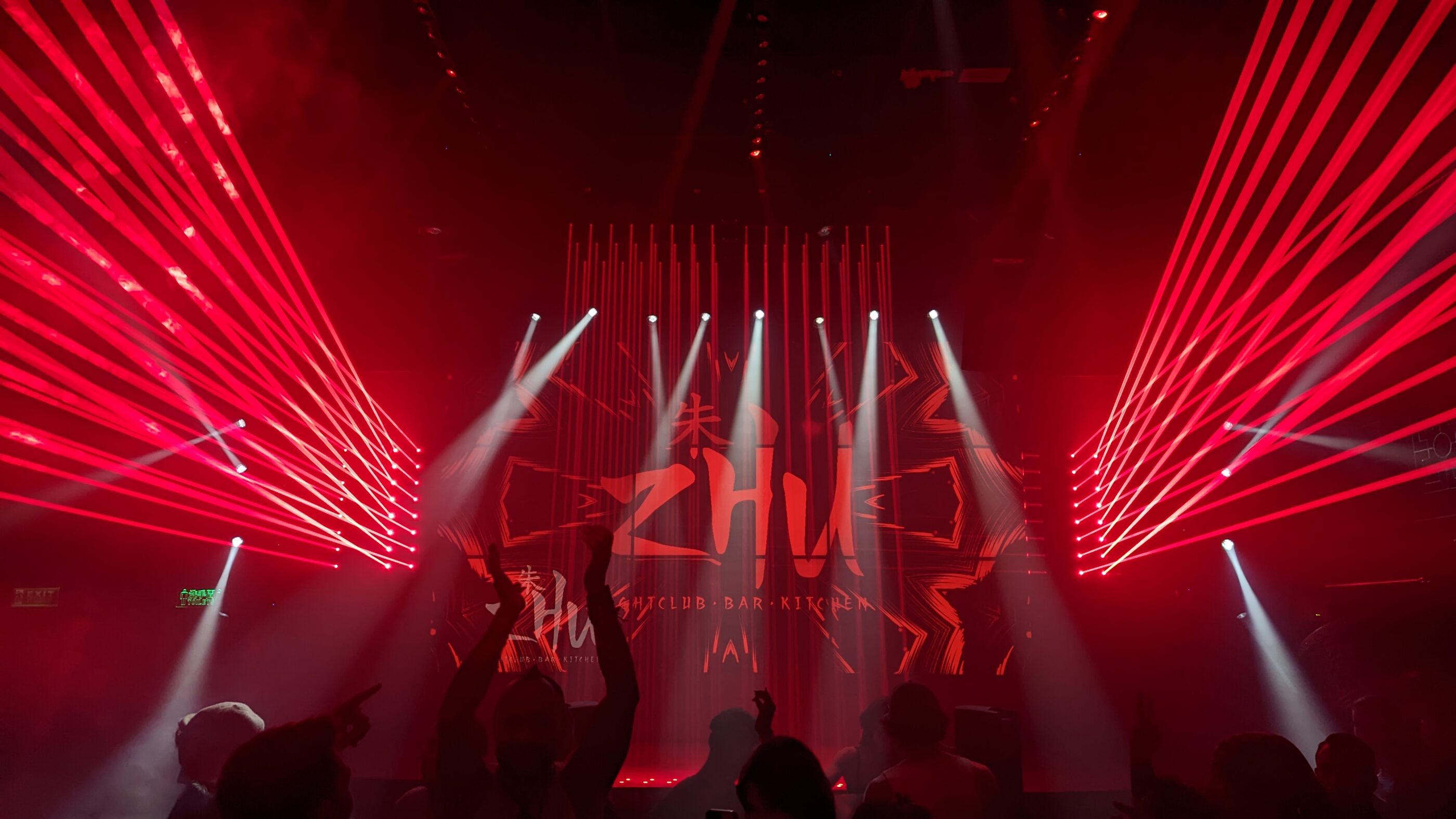
For venues of 300-600 capacity (like Moulin Rouge, Zhu, Unique, Yuuhi in Phuket), appropriate line array configurations typically include 6-12 elements per side. Smaller venues might use compact line arrays or point-source systems; larger spaces demand full-size touring arrays. The key isn’t using expensive equipment unnecessarily—it’s matching system capabilities to actual venue requirements.
Subwoofer Configuration
Bass reproduction separates adequate nightclub systems from exceptional ones. Electronic music demands powerful, controlled low-frequency output creating physical impact without boomy, indistinct rumble. Achieving this requires substantial subwoofer quantity and sophisticated configuration.
Cardioid subwoofer arrays have revolutionized nightclub bass. Traditional subwoofer placement radiates equally in all directions—forward toward guests but also backward toward neighbors, creating noise complaints. Cardioid configurations use precise spacing and delay to cancel rearward energy while maintaining forward output. Properly implemented cardioid arrays achieve 10-15 dB rear rejection, dramatically reducing external noise while improving in-venue bass quality.
Subwoofer quantity requirements surprise venue operators unfamiliar with professional audio. A 500-capacity nightclub might require 8-12 high-output subwoofers achieving target sound pressure levels. Under-specifying subwoofers creates the single most common nightclub audio failure—systems lacking visceral impact guests expect, forcing operators to overdrive inadequate equipment causing distortion and damage.
Amplification and Power Requirements
Professional nightclub systems demand substantial amplification. A medium venue (400-500 capacity) requires 20,000-40,000 watts total system power. Large venues exceed 60,000-80,000 watts. These numbers shock operators accustomed to residential audio, but they’re necessary for target sound pressure levels with adequate headroom preventing distortion.
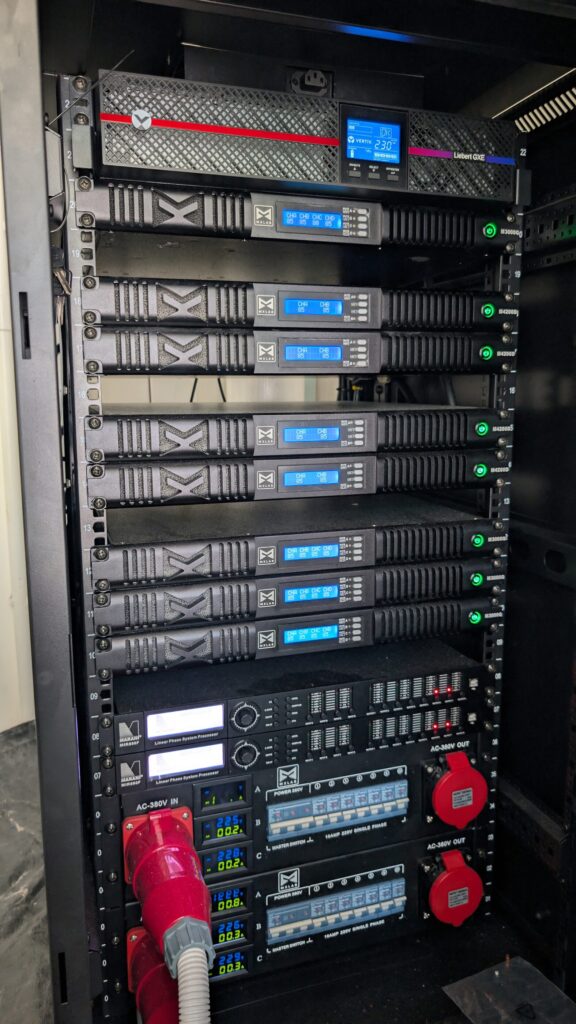
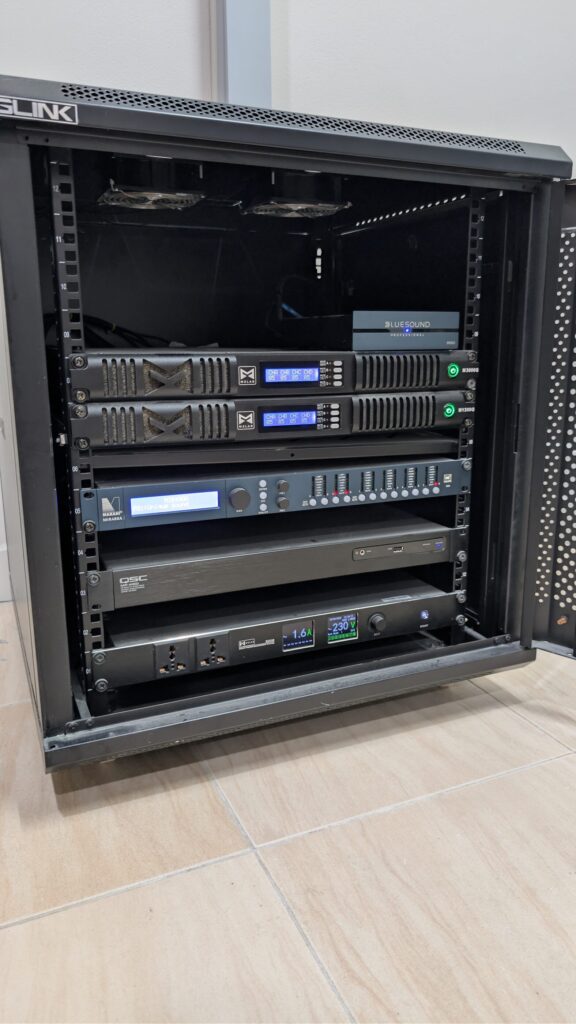
Modern amplifier technology makes these power levels manageable. Class-D amplifiers deliver high power in compact form factors with minimal heat generation. Single-rack-space amplifiers provide 10,000+ watts across four channels. Networked amplifier control enables system-wide monitoring and adjustment from central locations.
Electrical infrastructure must support power demands. A 40,000-watt audio system draws 150-200 amps assuming reasonable efficiency. Venues require dedicated electrical circuits with appropriate breakers, proper grounding preventing noise, and sufficient capacity for simultaneous lighting, HVAC, and other loads. Inadequate electrical infrastructure causes the most expensive installation problems—discovering power limitations after equipment purchase requires costly electrical upgrades or system redesign.
Digital Signal Processing
DSP systems form the intelligence of modern nightclub audio. Processors handle speaker crossovers, equalization, limiting, delay alignment, and system optimization. Quality DSP separates professional installations sounding cohesive and controlled from amateur systems sounding harsh and fatiguing.
Speaker system optimization requires measurement microphones, analysis software, and experienced engineers. Installers measure frequency response throughout the venue, identify problematic resonances and reflection patterns, apply corrective equalization, set appropriate limiters protecting equipment, and align delays ensuring coherent summation. This optimization process typically requires 1-2 days post-installation and dramatically improves perceived sound quality.
System presets stored in DSP enable different configurations for various events. A “DJ night” preset might emphasize bass impact and high SPL capability. An “opening hours” preset reduces output levels for early crowds. “Live performance” presets route microphones and adjust processing for bands. This flexibility maximizes venue versatility without requiring technical staff intervention.
Acoustic Challenges
Noise Control for Neighboring Properties
Nightclub noise complaints represent the primary operational threat for venues. Excessive sound levels reaching neighbors generate complaints to authorities, resulting in fines, operating restrictions, or closure. Professional acoustic design addresses external noise before installation begins.
Building isolation creates the first defense. Venue shells require substantial mass—concrete walls, heavy doors, isolated construction separating venue structure from adjacent buildings. Acoustic treatments on walls and ceilings absorb internal reflections while blocking external transmission. These construction measures often exceed audio equipment costs but provide essential foundation for successful operation.
Cardioid subwoofer arrays deliver dramatic external noise reduction. The Moulin Rouge Phuket installation achieved 4x noise reduction (12 dB) using cardioid subs versus previous omnidirectional configuration. This improvement allowed higher internal levels without increasing external impact—a significant competitive advantage in dense entertainment districts.
Monitoring systems tracking sound levels provide operational protection. Permanently installed measurement microphones at property boundaries feed DSP limiters automatically reducing output when approaching limits. This automation prevents violations while maintaining maximum safe levels, optimizing guest experience without risking compliance.
Internal Acoustics and Reflections
Nightclub spaces often feature hard surfaces creating acoustic challenges. Concrete floors, plastered walls, and high ceilings generate long reverberation times and harsh reflections degrading clarity. Without treatment, these spaces sound boomy and indistinct regardless of equipment quality.
Strategic acoustic treatment addresses problematic reflections without creating dead spaces. Fabric-wrapped absorption panels on walls reduce flutter echoes. Cloud panels suspended from ceilings control overhead reflections. Bass traps in corners absorb low-frequency energy accumulating in room modes. Treatment balances absorption (controlling reverb and reflections) with liveliness (maintaining energy and excitement).
Budget constraints force prioritization. First-reflection points—walls directly opposite speakers, ceiling areas above dancefloors—deliver maximum impact per dollar spent. Complete acoustic treatment might cost 500,000-1,500,000 THB; strategic treatment targeting critical areas achieves 70-80% of full treatment benefit for 30-40% of cost.
Outdoor and Semi-Outdoor Venues
Thailand’s climate encourages outdoor and rooftop venues creating unique acoustic challenges. Open-air spaces lack reflective boundaries containing sound, requiring higher output levels achieving target coverage. Ambient noise from traffic, neighboring venues, and weather increases required signal-to-noise ratios. Equipment must withstand exposure to humidity, rain, and temperature fluctuations.
Weatherproofing extends beyond basic water resistance. Marine-grade speakers feature stainless steel hardware, UV-resistant enclosures, and sealed connections. Amplifier racks require climate-controlled enclosures maintaining stable temperature and humidity. Cabling uses outdoor-rated jacketing and waterproof connectors. These specifications increase costs 30-50% versus indoor installations but provide essential longevity in tropical environments.
Sound propagation in outdoor venues requires different design approaches. Without walls and ceilings focusing energy, speaker systems need tighter control preventing sound spreading to neighbors. Line arrays excel here—narrow vertical dispersion keeps energy on dancefloor rather than radiating skyward. Delay towers might be necessary for large outdoor spaces, synchronizing coverage across extended areas.
Equipment Selection for Nightclub Sound System Thailand Projects
Understanding Equipment Tiers
Nightclub audio equipment spans enormous price ranges reflecting capability and durability differences. Understanding these tiers helps operators make informed decisions matching budgets with requirements.
Professional Touring Grade: Brands like d&b audiotechnik and L-Acoustics represent top tier. These systems deliver uncompromising performance, bulletproof reliability, and comprehensive support networks. A 500-capacity venue system might cost 10-20M+ THB. This tier suits flagship venues, brands prioritizing reputation, and operators planning decades of service life.
Commercial Installation Grade: Brands like Martin Audio, QSC, and JBL Professional occupy this tier. Systems deliver excellent performance and reliability at lower costs than touring grade. A comparable system might cost 4-8M THB. This tier represents the sweet spot for most successful nightclub operations—professional performance without ultra-premium pricing.
Entry Professional Grade: Brands like MX LAB and Electro-Voice provide nightclub-capable systems at aggressive pricing. A system might cost 1.5-3M THB. Performance and longevity don’t match higher tiers, but these systems suit budget-conscious operations, secondary rooms, or venues expecting shorter equipment lifecycles.
The cost difference between tiers isn’t primarily sound quality—even entry-grade equipment sounds good when new. The difference emerges in reliability under sustained use, component longevity, technical support quality, and resale value. A venue running 6 nights weekly for 10 years faces very different economics than one operating weekends only.
Speaker System Selection
Speaker selection balances coverage requirements, aesthetic preferences, and budget constraints. Full-size line arrays deliver maximum performance but require substantial rigging and visual impact. Compact line arrays reduce visual presence while maintaining most performance benefits. Point-source systems cost less but sacrifice coverage uniformity.
Subwoofer selection focuses on output capability and configuration flexibility. Dual-18″ subwoofers deliver more output than single-18″ designs. Front-loaded designs respond faster with tighter transients; horn-loaded designs maximize efficiency. Cardioid-capable subwoofers cost more but provide crucial noise control for urban venues.
Driver quality separates professional equipment from consumer gear. Neodymium magnet structures reduce weight while maintaining performance. High-temperature voice coils survive sustained high-power operation. Rigid cone materials minimize distortion at high excursion. These technical specifications directly correlate with longevity and reliability.
Amplifier and Processing Selection
Modern networked amplifiers revolutionized system management. Dante, AES67, or proprietary networks enable centralized monitoring and control. Engineers adjust any parameter from central locations without physical rack access. Automated monitoring detects developing problems before failures occur—overheating, clipping, impedance changes signaling speaker damage.
Amplifier power ratings require understanding. Continuous power ratings indicate sustainable long-term output. Peak ratings (often prominently advertised) measure brief transient capability. Professional installations focus on continuous ratings with 30-50% headroom, ensuring amplifiers operate comfortably below maximum capability even during demanding passages.
DSP platform selection affects long-term flexibility. Open-architecture processors accept third-party speakers and amplifiers. Proprietary systems lock venues into specific brands. The trade-off: proprietary systems offer tighter integration and easier optimization, while open platforms provide equipment choice and competitive pricing on replacements and expansions.
Case Studies from Phuket
Moulin Rouge Phuket
Moulin Rouge faced a common urban nightclub challenge: achieving powerful internal sound without disturbing neighbors. The 400-capacity venue operates in a mixed-use area with residential properties nearby. Previous installations generated complaints forcing volume restrictions that diminished guest experience.
The solution centered on cardioid subwoofer configuration. Twelve high-output subwoofers arranged in cardioid arrays delivered deep bass impact inside the venue while achieving 12 dB rear rejection. External measurements showed 4x noise reduction versus previous omnidirectional configuration. Internal sound pressure levels increased 6 dB while external levels decreased 6 dB—a 12 dB total improvement in the venue’s operational margin.
Line array main systems (8 elements per side) provided even coverage across the dancefloor. Comprehensive DSP optimization tuned frequency response for the room’s acoustic characteristics. The result: crystal-clear audio at high SPL, powerful visceral bass, and zero noise complaints since installation. The venue now operates at higher levels than previously possible, creating competitive advantage in Phuket’s nightlife market.
Zhu, Unique, and Yuuhi
These three venues represent successful medium-capacity installations (300-600 guests) demonstrating different equipment tier approaches. Each selected systems matching their specific operational priorities and budget constraints.
Zhu prioritized maximum impact within moderate budget, selecting commercial-grade systems delivering excellent performance-to-price ratio. Unique emphasized brand prestige, investing in premium touring-grade equipment reflecting the venue’s upscale positioning. Yuuhi balanced performance and aesthetics, choosing compact line arrays minimizing visual impact while maintaining sonic quality.
All three venues share common success factors: professional acoustic treatment addressing room reflections, comprehensive DSP optimization by experienced engineers, proper electrical infrastructure supporting power demands, and ongoing maintenance preserving performance. The specific equipment brands mattered less than correct system design and professional installation execution.
Installation Process
Professional nightclub audio installation follows structured phases minimizing venue downtime and ensuring systematic execution.
Pre-Installation Planning
Detailed planning prevents costly mid-installation discoveries. Site surveys document structural conditions, electrical infrastructure, rigging points, and access constraints. Acoustic measurements identify problematic room modes and reflection patterns. 3D acoustic modeling predicts coverage patterns and identifies optimal speaker positions.
Rigging engineering ensures structural adequacy for suspended equipment. Line arrays impose significant loads—a full system might weigh 500-800 kg per side. Professional engineers calculate stress on rigging points, specify appropriate hardware, and coordinate with structural engineers verifying building capacity. Inadequate rigging creates catastrophic safety hazards and liability.
Electrical coordination with venue electricians prevents surprises. Installation teams provide detailed power requirements, circuit specifications, and grounding needs. Electricians prepare appropriate circuits before equipment arrival. This coordination minimizes installation delays and prevents discovering electrical inadequacy after equipment purchase.
Physical Installation
Equipment installation typically requires 2-3 weeks for medium venues, longer for complex projects. Line array rigging demands precision—millimeter-level positioning and aiming accuracy affects coverage uniformity. Installers use laser measuring tools and manufacturer software calculating exact angles and positions.
Subwoofer placement and configuration requires acoustic knowledge. Cardioid arrays demand precise spacing and time alignment achieving rear cancellation. Ground-stacking versus flying affects low-frequency coupling and output. Professional installers measure results verifying predicted performance.
Cable infrastructure represents unglamorous but critical work. Proper cable management prevents failures, simplifies troubleshooting, and enables future modifications. Professional installations use labeled cables, organized pathways, and service loops accommodating equipment changes. Amateur installations create rat’s nests causing ongoing maintenance problems.
System Optimization and Commissioning
Post-installation optimization transforms equipment into cohesive systems. Engineers measure frequency response at multiple locations, apply corrective equalization reducing peaks and nulls, set crossover parameters optimizing driver integration, align delays ensuring coherent summation, and program limiters protecting equipment while maximizing clean output capability.
This optimization requires specialized measurement equipment and expertise. Installers use measurement microphones, FFT analyzers, and prediction software. The process typically requires 2-3 days. Results dramatically improve sound quality—the difference between systems sounding harsh and fatiguing versus powerful and clear.
Staff training ensures proper operation and basic troubleshooting. Training covers startup/shutdown procedures, preset selection, gain staging for DJ equipment, monitoring networked amplifier status, and recognizing problems requiring professional service. Well-trained staff prevent misuse causing damage and maintain optimal performance.
Common Mistakes to Avoid
Inadequate Subwoofer Specification
The most common nightclub audio failure: insufficient bass capability. Operators underestimate subwoofer requirements, specify too few units, or choose underpowered designs. The result: systems lacking visceral impact, forcing overdrive causing distortion and damage, and guest dissatisfaction.
Professional designs specify 25-40% more subwoofer capacity than mathematically required, providing headroom for dynamic peaks and ensuring clean output at target levels. This might mean 10-12 subwoofers where calculations suggest 8 would suffice. The additional cost (15-20% of system budget) delivers dramatically improved performance and longevity.
Ignoring Acoustic Treatment
Expensive speaker systems can’t overcome poor room acoustics. Operators sometimes invest millions in equipment while neglecting thousand-baht acoustic treatment, then wonder why systems sound harsh and indistinct. Sound waves reflect off hard surfaces regardless of equipment quality—physics doesn’t care about brand names.
Minimum viable acoustic treatment—addressing first-reflection points and controlling excessive reverberation—costs 200,000-500,000 THB for medium venues. This investment delivers more sonic improvement per baht than any equipment upgrade. Professional installers refuse projects lacking adequate acoustic treatment, knowing results will disappoint regardless of equipment quality.
Electrical Infrastructure Oversights
Discovering electrical inadequacy after equipment purchase creates expensive problems. Upgrading electrical service, installing appropriate circuits, and implementing proper grounding might cost 300,000-800,000 THB. These costs exceed many equipment budgets but become unavoidable once inadequacy is revealed.
Professional projects coordinate electrical requirements early. Power system analysis identifies limitations before equipment commitment. Electrical upgrades happen during venue construction or renovation rather than emergency mid-installation. This planning prevents cascading delays and budget overruns.
Choosing Based Purely on Price
The lowest quote rarely delivers best value. Inexperienced installers underbid by omitting necessary components, underestimating installation complexity, or specifying inadequate equipment. Initial savings evaporate through poor performance, frequent service calls, and early replacement.
Professional nightclub sound system Thailand installations cost more initially but deliver appropriate solutions, quality execution, comprehensive optimization, ongoing support, and long-term reliability. A venue operating 10 years faces very different economics than one replacing failed systems every 2-3 years. Total cost of ownership—not initial purchase price—determines true value.
Maintenance and Long-Term Operation
Preventive Maintenance
Professional nightclub systems require regular maintenance preserving performance and preventing failures. Quarterly inspections check electrical connections, clean dust accumulation from amplifiers and speakers, verify rigging hardware integrity, update software and firmware, and test protection systems. These preventive measures cost far less than emergency repairs.
Component replacement schedules extend system life. Speaker drivers experience mechanical wear—foam surrounds deteriorate, voice coils develop issues. Replacing drivers on schedule prevents mid-session failures. Amplifier electronics have finite lifespans—capacitors dry out, cooling fans fail. Scheduled maintenance catches developing problems early.
Environmental factors accelerate maintenance needs. Coastal venues face accelerated corrosion requiring more frequent inspections. Dusty environments need filter cleaning. Venues with smoke or haze machines experience faster accumulation on speakers. Maintenance schedules adapt to specific environmental conditions rather than following generic intervals.
Performance Monitoring
Networked systems enable proactive monitoring preventing problems. Amplifiers report temperature, output levels, and fault conditions. Anomalies trigger alerts—excessive temperature indicating blocked cooling, unusual impedance suggesting speaker damage, recurring clipping pointing to gain structure problems. This monitoring prevents catastrophic failures by catching issues early.
Periodic system measurements verify maintained performance. Annual or bi-annual measurements compare current frequency response against installation baseline. Deviations indicate developing problems—speaker damage, electronic drift, or acoustic changes from venue modifications. These measurements guide corrective action before guests notice degradation.
System Upgrades and Evolution
Technology advancement creates upgrade opportunities. New DSP platforms offer improved processing and networking. More efficient amplifiers reduce power consumption and heat. Advanced speakers deliver better performance in the same footprint. Planning upgrade paths during initial installation simplifies future improvements.
Modular system design enables incremental upgrades. Adding subwoofers increases bass capability. Upgrading processors improves system intelligence. Replacing amplifiers with networked models enables better monitoring. These upgrades extend system life and performance without complete replacement. For venues also considering LED video wall upgrades, planning audio and video infrastructure together saves significant cost.
Why Choose Professional Nightclub Sound System Thailand Installers
Professional nightclub audio installation differs fundamentally from hiring “a sound guy” or using DJ equipment in club environments. The engineering approach begins with acoustic analysis and detailed design rather than equipment selection. Professional installers understand room acoustics, calculate coverage mathematically, model systems predicting performance, and optimize results through measurement.
Multi-brand expertise allows optimal equipment selection rather than forcing single-manufacturer solutions. Professional integrators specify equipment matching requirements and budgets, mixing brands when appropriate. This flexibility delivers better value than dealer-installers promoting preferred brands regardless of suitability.
Comprehensive project management coordinates electrical, structural, and installation trades. Professional teams handle rigging engineering, electrical coordination, acoustic treatment, equipment installation, system optimization, and staff training. This turnkey approach prevents coordination failures plaguing projects with separate contractors managing individual aspects.
Ongoing support and monitoring extend relationships beyond installation. Professional installers maintain detailed documentation, provide priority service, offer system health monitoring, and advise on upgrades and expansions. This long-term support maximizes investment value while minimizing operational disruption.
Clubtek Thailand brings specialized nightclub expertise, multi-brand knowledge, and proven track record (Moulin Rouge, Zhu, Unique, Yuuhi) to audio installation throughout Phuket and Thailand. Our approach combines acoustic analysis, professional-grade equipment from brands like d&b audiotechnik, L-Acoustics, Martin Audio, and MX LAB, and comprehensive support ensuring venues deliver exceptional sonic experiences night after night.
Ready to Transform Your Venue’s Audio Experience?
Professional nightclub audio systems create the immersive sonic experience that drives guest satisfaction, social media buzz, and competitive advantage in Thailand’s intense nightlife market. Whether you’re opening a new venue or upgrading an existing club, investing in proper audio installation delivers measurable returns through improved reputation and guest loyalty.
Contact Clubtek Thailand for a professional consultation:
📱 WhatsApp: +66 95 428 8420
🌐 Website: clubtek-th.com
Our team provides free site surveys, detailed proposals, and 3D acoustic modeling for complex projects. Let us show you how professional audio installation transforms your nightclub’s guest experience.
Related Sound System Guides for Other Venue Types in Thailand
Nightclub audio is the most demanding sound system category, but the engineering principles extend across hospitality. Read our parallel deep guides for other venue types: restaurant sound system Phuket installation guide, hotel and resort multi-zone audio, beach club coastal sound design, rooftop bar audio in Phuket, karaoke and KTV venues, and gym and fitness center sound systems. For the underlying speaker technology, see our comparison of line array vs point source speakers. Across all venue types, the Clubtek team handles design, installation, and ongoing support — including projects in Pattaya and the Phuket, Samui, and Phangan markets.
Related coverage
For Phangan’s nightlife scene and full moon party venues, see our guide on Koh Phangan audio installation. For Pattaya’s nightclub circuit, see our guide on Pattaya AV installation.