Professional audio systems for hotels, resorts, nightclubs, and entertainment venues. Distributed audio, concert-grade equipment, and multi-zone control from 50 to 2,000+ capacity
Unified control systems integrating audio, video, lighting and building management through professional automation platforms for hotels and restaurants.
Networked Audio for Multi-Building Resorts in Thailand: Dante, AES67, and Q-SYS Engineering Guide (2026)
TL;DR — Networked Audio for Multi-Building Resorts in Thailand (2026)
Once a property exceeds three buildings or four audio zones, analog audio cabling stops being practical. Dante (Audinate) is the de-facto standard in 2026 with 3,300+ certified products, with AES67 used as an interoperability layer to bridge other audio-over-IP ecosystems. AVB has lost the market — only a small set of MILAN-compliant products remain commercially relevant. For Thai resorts spanning lobby, restaurant zones, ballroom, spa, gym, pool, and villa BGM, a single Dante backbone over fiber (1Gbps Cat6a inside buildings) is the most cost-effective and future-proof design. Budget ranges from 800,000฿ for a 4-zone single-building system to 6M฿+ for a fully meshed 16-zone multi-building resort.
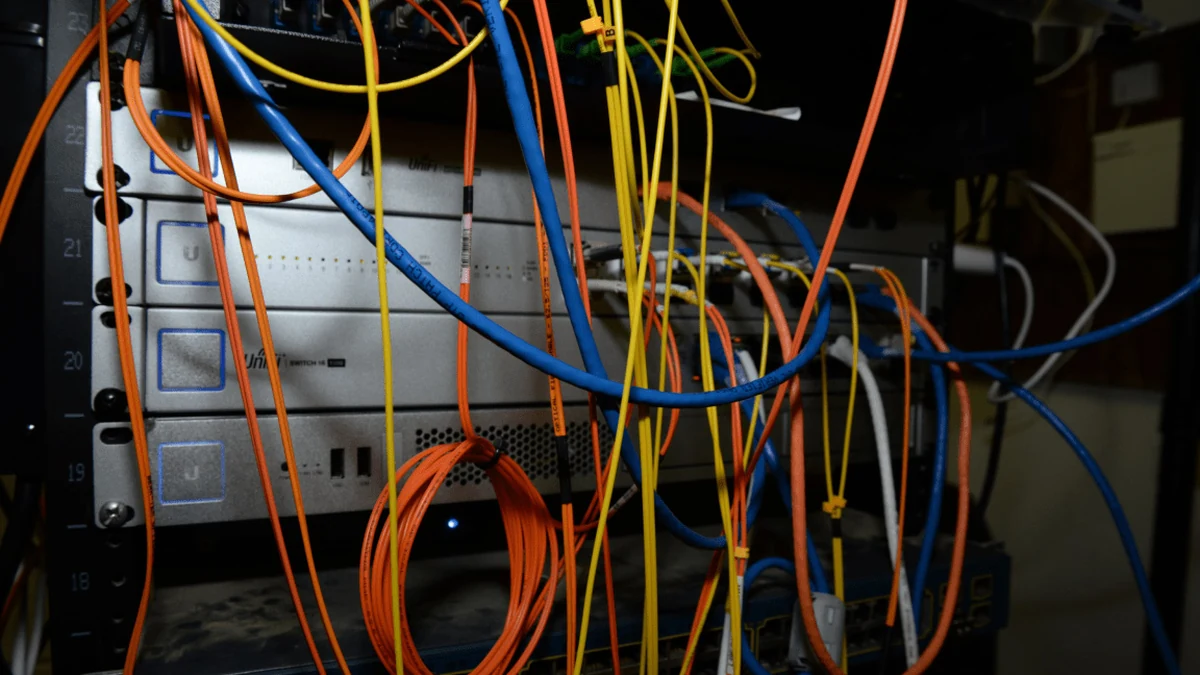
Server rack with networking devices and patch cables. Public Domain via Wikimedia Commons (US FBI)
Why Multi-Building Thai Resorts Outgrow Analog
A typical Thai beach or hillside resort with 80–150 keys has 6 to 12 buildings spread across 50 to 200 meters: main lobby, beach restaurant, pool bar, signature restaurant, spa, gym, conference suite, ballroom, kids club, villa cluster, and back-of-house. Each of these is a separate audio zone with independent volume, source selection, and scheduling needs.
Analog audio doesn’t scale here. Three reasons it breaks:
Distance. Balanced analog audio over copper degrades over runs longer than about 100 meters. Most Thai resorts have building-to-building distances of 80–250 m. Running analog requires costly distribution amplifiers and impedance matching at each end.
Channel count. A 12-zone resort with 4 sources each needs 48 analog channels routed between source rack and destinations. That’s a 48-pair multicore between every building. Cost and labor become absurd.
Flexibility. When the GM decides next week that the pool bar should also receive the ballroom feed during DJ events, repatching analog means re-cabling. With networked audio, it’s a software change in a designer file.
Networked audio (audio over IP, often abbreviated AoIP) solves all three at once: a single fiber pair between buildings carries hundreds of audio channels with sub-millisecond latency, and routing happens in software.
Three Protocols Compared (and One That’s Effectively Dead)
PH4 — the de-facto standard
Dante is a commercial audio-over-IP solution from Audinate. Two key facts about its 2026 position:
Over 3,300 Dante-certified products on the market across more than 600 manufacturers. New products added in the last 12 months alone: 472.
Standard 1Gbps Ethernet networks support up to 512×512 channels per network. Modern Dante AV Ultra extends this to networked video.
Dante runs on commodity managed switches (no special hardware required beyond QoS support and IGMP snooping), uses standard CAT6a copper inside buildings and fiber between buildings, and is now natively supported by every serious pro audio manufacturer: Yamaha, Allen & Heath, Shure, Sennheiser, Bose, Symetrix, BSS, Crown, QSC, Yamaha, Soundcraft. For a resort install in 2026, Dante is the default choice unless there’s a specific reason to deviate.
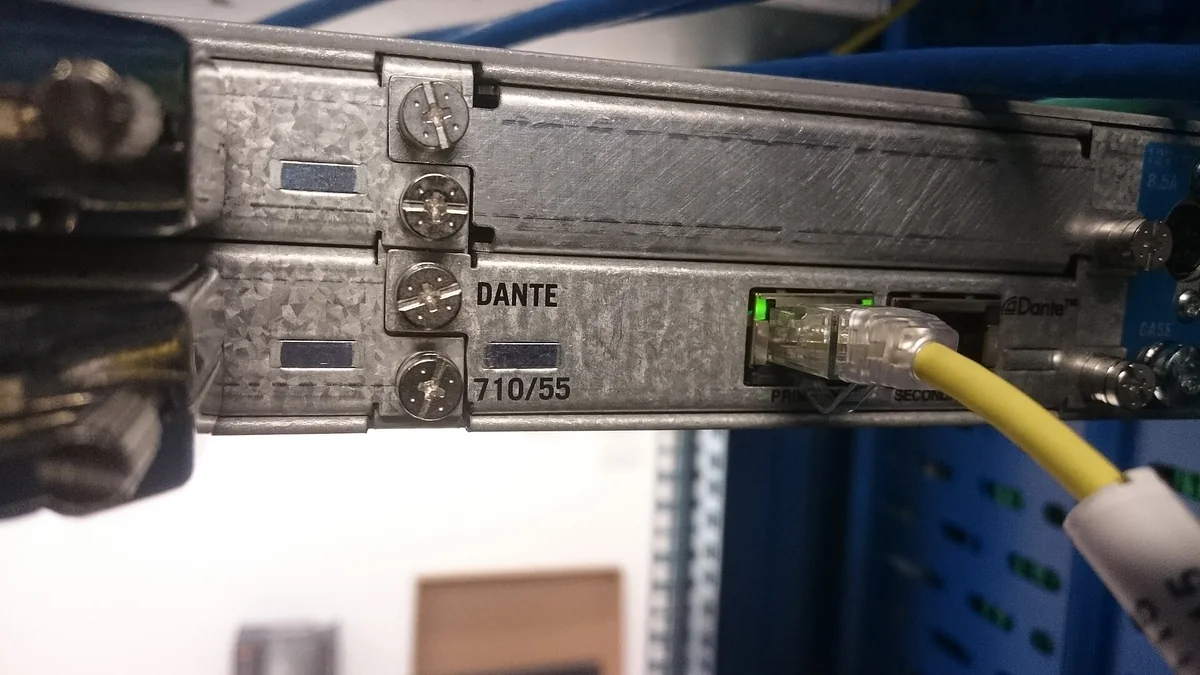
Dante audio network interface — used by 600+ pro audio manufacturers in 2026. CC0 via Wikimedia Commons (Morningfrost)
PH5 — the interoperability layer
AES67 is an Audio Engineering Society standard (not a product) that defines how different audio-over-IP ecosystems can interoperate. Modern Dante devices include AES67 mode, which lets a Dante network exchange channels with Ravenna, Livewire+, WheatNet-IP, or any other AES67-compliant system.
For a resort, AES67 matters in one realistic scenario: the conference center is run by an external AV contractor whose system is on Ravenna or another platform, and the integrated resort backbone needs to receive a feed of conference audio for the lobby broadcast or in-room IPTV audio. AES67 bridges the two without requiring matched manufacturers on both sides.
PH6 — effectively retired in pro install
AVB was once positioned as the IEEE-standardized competitor to Dante. As of 2026, its install-market presence is minimal. Only around 45 MILAN-compliant products exist, and even between MILAN products, true interoperability is inconsistent. AVB also requires AVB-certified Ethernet switches, which cost more than commodity managed switches and have a narrower vendor list.
For Thai resort installs, do not specify AVB or MILAN unless a specific equipment requirement forces it. The manufacturer support, switch availability, and Thai distributor warranty paths are all weaker than Dante.
Q-SYS Q-LAN — proprietary, but with native Dante
QSC’s Q-SYS platform uses its own proprietary networking layer called Q-LAN. Historically this was a closed alternative to Dante. Since QSC’s introduction of software-based Dante for the Q-SYS Core ecosystem, Q-SYS systems can now process Dante channels natively without bridging hardware. This means a resort can standardize the central DSP and control on Q-SYS while still using Dante-equipped wireless microphones, networked amplifiers, and ceiling speakers from any vendor.
Q-SYS is a premium choice (USD 6,000+ for a Core 110f, more for higher tiers) but the integrated control, DSP, scheduling, and management make sense for full-service luxury resort installations.
Mapping Protocols to Resort Subsystems
A 100-key Thai resort with a typical layout will have these networked audio subsystems. The protocol choice rarely varies — Dante for everything is the right answer in 2026 — but the device selection and zone count do.
Subsystem
Typical channel count
Recommended devices
Main lobby + arrival lounge
2–4 zones, 2–4 sources
Symetrix or BSS Soundweb networked DSP with Dante; ceiling speakers via networked amplifiers (Crown DCi-N, Powersoft Quattrocanali)
Beach restaurant + pool bar
2–6 zones (indoor/outdoor split)
IP65–IP67 outdoor speakers (JBL Control X, Bose FreeSpace) on networked amps; weatherproof Dante endpoints
Conference / ballroom
4–16 zones, wireless mic system
Yamaha QL/CL or Allen & Heath dLive console with Dante I/O; Shure ULX-D or QLX-D Dante-enabled wireless mics
Spa
3–6 zones (treatment rooms + relaxation)
Low-channel-count Dante endpoints with whisper-quiet IP66 ceiling speakers
Gym
1–2 zones plus video sync
Dante-enabled amplifier with networked source selection; subwoofers required for spinning/HIIT studios
Kids club / activity rooms
1–2 zones
Simple Dante endpoint with local volume; centrally controlled curfew schedule
Villa cluster BGM (optional)
1 zone per villa, opt-in
Dante endpoint per villa cluster, in-villa source typically Sonos or Crestron over local Ethernet
Back-of-house paging
1–3 zones
Dedicated paging zone on Dante; priority ducking via central DSP
Engineering for Thai Resort Reality
Fiber backbone between buildings
Copper Ethernet (Cat6a) is limited to 100 m per run. A Thai resort with building-to-building distances of 50 to 250 m must use multi-mode or single-mode fiber between buildings, with copper only inside each building. A typical backbone uses single-mode fiber with SFP+ transceivers at 10 Gbps, terminated in a central MDF (Main Distribution Frame) in the BOH building and IDFs (Intermediate Distribution Frames) in each major building.
Fiber has the additional benefit of complete electrical isolation — important in Thailand where ground potential differences between buildings during the wet season can damage Ethernet equipment. Always use fiber, not copper, between buildings.
VLANs and QoS
Dante traffic must be on its own VLAN, with strict priority QoS queuing for PTP clock packets and a separate priority queue for Dante audio. Mixing Dante with general guest Wi-Fi traffic on the same VLAN is a guarantee of audio dropouts. Recommended switches: Netgear M4250 AV-Line series, Cisco Catalyst with AV preset, or Luminex Gigacore (purpose-built for AoIP networks).
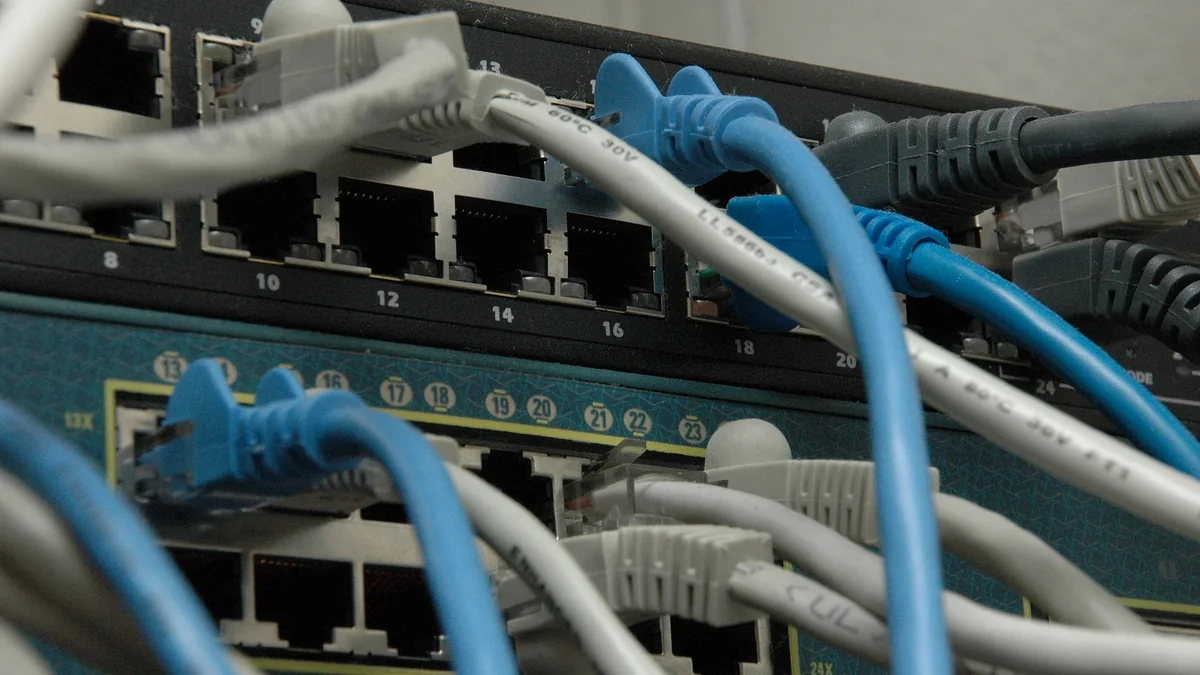
Managed AV-line network switches stacked in a rack — required for QoS and IGMP snooping in Dante networks. CC BY-SA 3.0 by ShakataGaNai via Wikimedia Commons
If the resort also uses Power over Ethernet for ceiling speakers and access points, budget the PoE wattage per switch carefully. A typical 48-port PoE+ switch delivers around 720W total — easily exhausted by a mix of 60W ceiling speakers and 25W APs.
Lightning and surge protection
Phuket, Samui, Phangan, and Krabi all experience intense lightning during the May to October monsoon season. Every fiber media converter and every copper Ethernet port that exits a building should pass through a surge protector rated for Ethernet (Type 3 SPD). The cost is small (≈1,500–3,000฿ per port) and the alternative is replacing destroyed network cards and DSPs after every major storm.
Redundancy
Dante supports primary/secondary network redundancy — each Dante device has two Ethernet ports, and a parallel secondary network carries identical audio. If a switch, fiber link, or cable fails on the primary, the device automatically continues using the secondary with no audible interruption. For any resort install above 8 zones or any venue that depends on uninterrupted audio (conference center, ballroom, spa), specify and deploy dual networks from day one. Adding redundancy after the fact requires re-cabling every Dante endpoint.
Reference Topology — 6-Building Resort, 12 Audio Zones
For a representative 100-key Thai beach resort with main lobby, beach restaurant, pool bar, signature dining, spa, and gym buildings:
BOH server room (MDF): Q-SYS Core 110f or Symetrix Prism main DSP; Dante PRIMARY/SECONDARY 24-port AV-line switches; main amplifier rack with 4× 8-channel Dante amplifiers (Crown DCi-N or Powersoft Quattrocanali)
Fiber backbone: 6× OS2 single-mode fiber pairs from MDF to each building IDF (one redundant pair per building); 10 Gbps SFP+ transceivers
Each building IDF: 8-port AV-line PoE switch; Dante endpoint (Yamaha Rio, Symetrix xIn/xOut, or QSC NV-Series) feeding local ceiling and surface speakers
Wireless microphone: Shure ULX-D quad-channel system with Dante output, used at ballroom + signature restaurant for events
Source rack: 4-channel Tascam BB-Series networked source players for streaming/scheduled playlists; CD-DJ inputs for events; computer audio for promotional content
Control: Q-SYS UCI panels on iPads at each building front-of-house location for staff control; central scheduling via Q-SYS Designer
Budget Ranges for Thai Resort Networked Audio (2026, THB)
All ranges are for fully engineered, designed, and commissioned installs including all hardware, fiber, switches, cabling, programming, training, and 12 months of remote support. (See: NBTC wireless microphone frequency and licensing guide for Thailand venues.) Building-to-building distances assumed at 50–100 m typical; longer distances add fiber and surge protection cost.
System scale
Hardware budget
Engineering & install
Total range
Single-building, 4 zones (boutique hotel, restaurant cluster)
400,000–700,000฿
200,000–400,000฿
600K–1.1M฿
3-building, 8 zones (small resort, 60–80 keys)
900,000–1,600,000฿
500,000–900,000฿
1.4M–2.5M฿
6-building, 12 zones (mid-size resort, 100–150 keys)
1,800,000–3,000,000฿
900,000–1,600,000฿
2.7M–4.6M฿
10+ building, 16–24 zones (large luxury resort, ballroom + conference)
3,500,000–6,000,000฿
1,500,000–3,000,000฿
5M–9M฿+
Hardware budgets dominate at small scale; engineering and commissioning costs grow at large scale because of zone programming, integration testing, QoS network design, and redundancy validation.
Common Mistakes
Putting Dante on the guest Wi-Fi VLAN. Predictable audio dropouts during peak guest traffic. Dante always gets its own VLAN with strict QoS.
Copper between buildings. Will work in dry season, will start to fail during the rains as ground potential drifts and surge events accumulate. Use fiber.
Skipping redundancy on day one. Adding secondary network later costs as much as building the primary did. Specify dual network from project start.
AVB nostalgia. Specifying AVB or MILAN in 2026 limits the device pool, raises switch costs, and creates warranty complications in Thailand. Use Dante.
Unmanaged switches. Consumer-grade unmanaged Gigabit switches don’t support IGMP snooping or QoS — Dante will work briefly and then fail unpredictably. Use AV-line managed switches throughout.
No surge protection on building-exit Ethernet. One storm = 50,000–200,000฿ of replaced equipment. Type 3 SPDs cost a few thousand baht per port.
No commissioning documentation. When the F&B GM changes 18 months later and the new manager wants to add a zone, with no documentation the integrator either has to redesign or charge for full discovery. Every install ships with a Dante Domain Manager export, a network diagram, and a written zone-to-source matrix.
Frequently Asked Questions
Can I use existing IT network infrastructure for Dante audio?
Only if the IT network supports VLAN isolation, IGMP snooping, and strict-priority QoS — and even then, Dante must be on its own VLAN with PTP clock packets given highest priority. For any resort install above 4 zones, a dedicated audio network with separate AV-line switches is the safer engineering choice. The cost of dedicated switches is small compared to the cost of troubleshooting intermittent dropouts caused by shared infrastructure.
How many Dante channels can a single network carry?
Standard 1Gbps Dante networks support up to 512 input and 512 output channels with end-to-end latency of about 1 millisecond at 48 kHz. Modern Dante AV Ultra extends the platform to networked video over the same infrastructure. For practical Thai resort installs, the channel count is never the limiting factor — switch port count and PoE budget are.
Is AES67 a replacement for Dante?
No. AES67 is an interoperability standard, not a product. It defines how different audio-over-IP ecosystems exchange channels. Modern Dante devices support AES67 mode, allowing a Dante network to bridge with Ravenna, Livewire+, WheatNet-IP, or other AES67-compliant systems. The base infrastructure for a new install in 2026 should still be Dante; AES67 is added as a bridging layer when integration with a non-Dante system is required.
What about AVB or MILAN — are they viable in 2026?
For Thai resort installs, no. Dante has 3,300+ certified products from 600+ manufacturers, while MILAN has approximately 45 products with inconsistent interoperability even among themselves. AVB also requires AVB-certified Ethernet switches, which raises infrastructure cost without delivering Dante’s ecosystem depth. The exception is if a specific console or DSP requires AVB — but for a new design, Dante is the right default.
Do I need fiber between buildings, or is shielded copper enough?
Always fiber. Copper Ethernet is limited to 100 m per run, which excludes most resort building-to-building distances. More importantly, fiber provides complete electrical isolation between buildings, which protects equipment during Thailand’s lightning season. Single-mode OS2 fiber with SFP+ transceivers at 10 Gbps is the standard for new installs and costs a fraction of the equipment it protects.
What’s the typical commissioning timeline for a 12-zone resort?
For a 6-building, 12-zone Dante install, expect 8 to 12 weeks from contract signing: 2 weeks for design and procurement, 3 to 5 weeks for cabling and rack build, 2 weeks for device configuration and zone programming in Dante Controller (or Q-SYS Designer), and 1 to 2 weeks for commissioning, integration testing, redundancy validation, and staff training. Larger 16+ zone installs add 2 to 4 weeks.
How is networked audio supported and updated after install?
Properly engineered Dante systems are documented with a Dante Domain Manager export, network diagrams, and a zone-to-source matrix. Software updates for Dante firmware and Q-SYS designs are typically managed remotely under an annual service contract (60,000–200,000฿/year depending on system size). On-site service is required only for hardware failures or major reconfigurations.