A professional karaoke sound system Thailand venues install represents one of the most technically demanding segments in the entire commercial audio industry — yet it remains one of the most underestimated. Walk into a poorly designed KTV venue in Phuket and the problems are immediately obvious: feedback howling through microphones, unbalanced vocals lost beneath the backing track, sound bleeding between supposedly soundproof rooms, and singers straining to hear themselves over distorted speakers.
These are not minor inconveniences. They directly destroy the guest experience that karaoke venues sell. Customers come to sing, to feel like performers, to enjoy themselves with friends — and a badly designed karaoke sound system Thailand operators chose to save money on undermines every aspect of that experience. Yet most AV companies in the country treat karaoke as a simple combination of speakers and microphones, missing the engineering complexity that separates professional installations from amateur ones.
This guide explains what makes KTV audio uniquely challenging, what equipment and design principles deliver professional results, and what mistakes to avoid when investing in a karaoke venue. Whether you operate a single karaoke bar in a Phuket karaoke bar or a multi-room KTV complex on the islands, the seven essentials here will help you understand what a professional karaoke sound system Thailand venues can rely on actually requires — and how to evaluate the contractors competing for your project.
Why Karaoke Audio in Thailand Is Different From Any Other Venue Sound System
A nightclub sound system plays recorded music to a crowd. A restaurant audio installation delivers background ambiance for diners. A karaoke sound system Thailand operators rely on must do something fundamentally more complex: it must combine live human voices with recorded music, in real time, in small reflective rooms, while preventing the system from feeding back on itself. This is closer to a recording studio environment than a typical commercial installation — except it must work reliably night after night, operated by venue staff rather than trained engineers.
The combination of these requirements creates a unique set of technical challenges that no other commercial audio installation faces. Understanding these challenges is the first step toward designing or evaluating a karaoke sound system Thailand venues can depend on for years of professional service.
Live Microphones in Small Reflective KTV Rooms
KTV rooms are typically small — 4 to 8 meters across — with hard surfaces that reflect sound multiple times before it decays. When a live microphone operates in this environment alongside speakers playing both backing music and the singer’s amplified voice, every reflection re-enters the microphone, gets re-amplified, and reflects again. This is the textbook condition for acoustic feedback — the howling squeal that plagues amateur karaoke installations. Preventing it requires careful speaker placement (away from the microphone’s pickup pattern), proper microphone selection (cardioid or hypercardioid patterns that reject sound from behind), and digital signal processing that suppresses developing feedback before it becomes audible.

Voice and Music Balance
Professional KTV venues need a system that can balance the singer’s voice against the backing track in real time. The challenge is that the human voice and the vocal range of recorded music occupy the same frequency band — roughly 250 Hz to 4 kHz, with peak intelligibility around 1–3 kHz. When both compete in this range, the result is a muddy mix where neither the original vocalist nor the karaoke singer can be heard clearly. Professional systems use vocal ducking (automatic music level reduction when the microphone detects voice) and frequency-selective processing that creates space for the live voice without making the music sound thin or empty.
Multi-Zone Complexity Across Thai KTV Venues
Most karaoke venues in Thailand operate multiple private rooms simultaneously. Each room is its own acoustic space with different dimensions, materials, occupancy, and song selection. A professional karaoke sound system Thailand multi-room venues require treats each room as an independent audio zone with its own equipment, processing, and isolation. Cheap installations that share amplifiers across rooms or rely on basic speaker selectors create cross-talk between rooms, uneven loudness, and synchronization problems that frustrate guests.

Operator Reality in Thailand: Non-Engineer Staff Across Long Shifts
Unlike a concert venue where a trained engineer mixes every show, KTV rooms are operated by hospitality staff with no audio training, often during shifts of eight hours or longer. The system must sound great with default settings, recover gracefully from misuse (mic drops, accidental gain spikes, cable yanks), and require zero technical intervention during normal operation. This operator-reality constraint shapes nearly every design decision in a professional karaoke sound system Thailand installation — from controller layout to fault-tolerance to remote diagnostics.
Commercial KTV vs Home Karaoke in Thailand: Why the Equipment Cannot Cross Over
Most of the karaoke products visible in the Thai market — and almost all of the equipment competing for attention in online searches — are designed for home use. They are not suitable for commercial KTV venues, regardless of price tag. The two categories solve fundamentally different problems and the engineering trade-offs are incompatible.
| Specification |
Home Karaoke |
Commercial KTV |
| Duty cycle |
2–4 hours, occasional |
8+ hours, nightly |
| Microphones |
Consumer wireless, often VHF |
Dynamic cardioid, licensed UHF wireless |
| Amplifier headroom |
1:1 with speaker rating |
2:1 minimum to prevent clipping |
| Feedback management |
None or basic notch |
Adaptive multi-band suppression |
| Room isolation |
Not applicable |
Engineered for STC 55+ between rooms |
| Expected lifespan |
3–5 years light use |
7–10 years commercial duty |
| Service support |
Manufacturer warranty only |
Local technical support, remote diagnostics |
Owners attempting to save money by sourcing home equipment for a commercial karaoke sound system Thailand venues universally face the same outcome: equipment fails within 18–24 months, often during peak revenue hours, and the replacement cost plus lost revenue exceeds what professional equipment would have cost in the first place. (See: Thailand NBTC wireless microphone frequency rules and band allocations.)
7 Essential Components of a Professional Karaoke Sound System in Thailand
A complete karaoke sound system Thailand installations rely on consists of seven core components, each chosen and configured for the specific demands of live vocal reproduction in small rooms. Cutting corners on any of these elements typically produces cascading problems that affect the entire system.
1. Speakers for KTV Rooms in Phuket
Karaoke speakers must reproduce both bass-heavy backing tracks and clear vocal ranges without distortion. Two-way speakers with 8–10 inch woofers and dedicated tweeters typically suit medium rooms (10–20 square meters); larger VIP rooms benefit from three-way designs or compact line arrays. Ceiling-mounted speakers work for ambient music but are insufficient for singing applications — dedicated front-of-room speakers are essential. Subwoofers should be properly integrated, not just added as an afterthought; bad subwoofer integration creates the boomy, muddy bass that fatigues singers within minutes. Trusted commercial choices for KTV venues in Phuket include QSC, JBL Professional, and RCF for the speaker tier.
2. Microphones — Wireless Licensing in Thailand
Professional KTV venues across Thailand should use dynamic vocal microphones with cardioid or supercardioid patterns — the same fundamental technology used in live concert touring. The Shure SM58 and SM Beta 58A remain industry standards because they tolerate high sound pressure levels, resist feedback better than condensers, and survive being dropped or mishandled by enthusiastic singers. Wireless systems should operate on licensed UHF frequencies in Thailand to avoid interference; the cheapest VHF wireless systems often face interference from other electronic devices and become unusable during peak hours in dense urban RF environments. Sennheiser EW-D, Shure BLX, and Audio-Technica System 10 are common commercial-tier wireless systems suitable for any karaoke sound system Thailand venues deploy.
3. Mixers and Vocal Processors for Thailand KTV Installations
The mixer is the heart of any karaoke sound system Thailand installations rely on. Modern setups typically use compact digital mixers with built-in vocal processors that provide reverb, echo, pitch correction, and key adjustment. These features are not luxuries — they are what allow average singers to sound enjoyable rather than embarrassing, which directly affects whether guests come back. Quality vocal processors include dedicated karaoke modes calibrated specifically for recreational singing applications. Allen & Heath QU-SB, Behringer X32 Compact with KTV firmware, and dedicated KTV processors from BMB and JBK are commonly specified for Thai venues.
4. Amplification Built for Thai Operating Conditions
Quality KTV installations across Thailand require amplifiers properly matched to speaker requirements with substantial headroom — typically twice the speaker’s continuous power rating. This headroom prevents distortion during loud passages and protects speakers from the clipping that destroys drivers. Each room should have dedicated amplification channels, not shared multichannel amplifiers that create cross-talk between zones. Class-D commercial amplifiers from Crown, QSC, and Powersoft offer the efficiency, thermal performance, and reliability needed for nightly operation in Thailand’s tropical climate — particularly in coastal Phuket, Samui, Phangan, and Krabi venues where heat and humidity stress every component.
5. Acoustic Feedback Management in Thai KTV Rooms
Modern feedback management uses adaptive notch filters that automatically detect developing feedback frequencies and apply narrow cuts before audible howling occurs. This processing is essential for any karaoke sound system Thailand venues operate. Without it, even well-designed systems will eventually feed back as room conditions change — different occupancy, different microphone positions, different singing styles. The best feedback management runs continuously and invisibly, simply preventing problems before they happen. Sabine, Shure DFR series, and DSP-integrated solutions from Symetrix or BSS are typical professional choices.
6. Room Acoustic Treatment for KTV Venues in Thailand
No karaoke sound system can compensate for an acoustically untreated room. KTV rooms in Thailand — from Phuket shophouse conversions to purpose-built entertainment complexes — often feature hard surfaces such as tile floors, painted walls, and glass partitions that create excessive reverberation. Acoustic treatment using absorption panels on walls, diffusion elements on ceilings, and proper floor coverings reduces reverb time to the 0.4–0.6 second range that supports speech intelligibility while still allowing music to sound full. Acoustic treatment is not aesthetic decoration; it is engineering infrastructure that determines whether the room sounds professional or amateurish.
7. Inter-Room Isolation for Multi-Room Thai KTV Complexes
Sound bleed between karaoke rooms is one of the most common complaints in poorly designed venues. A guest in Room 3 should not hear the singing from Room 5. Proper isolation requires double-stud wall construction with insulation, decoupled ceiling structures, sealed door perimeters, and HVAC ducting designed to prevent sound transmission. This is partially an architectural decision — which is why audio engineers specifying a karaoke sound system Thailand multi-room venues need must be involved from the design phase, not after construction is complete.
Case Study: Opera Karaoke Club — Phuket
One of our reference KTV installations in Thailand is the Opera Karaoke Club in Phuket — a multi-room venue where Clubtek delivered the complete karaoke sound system Thailand engineering package across private rooms of varying sizes.
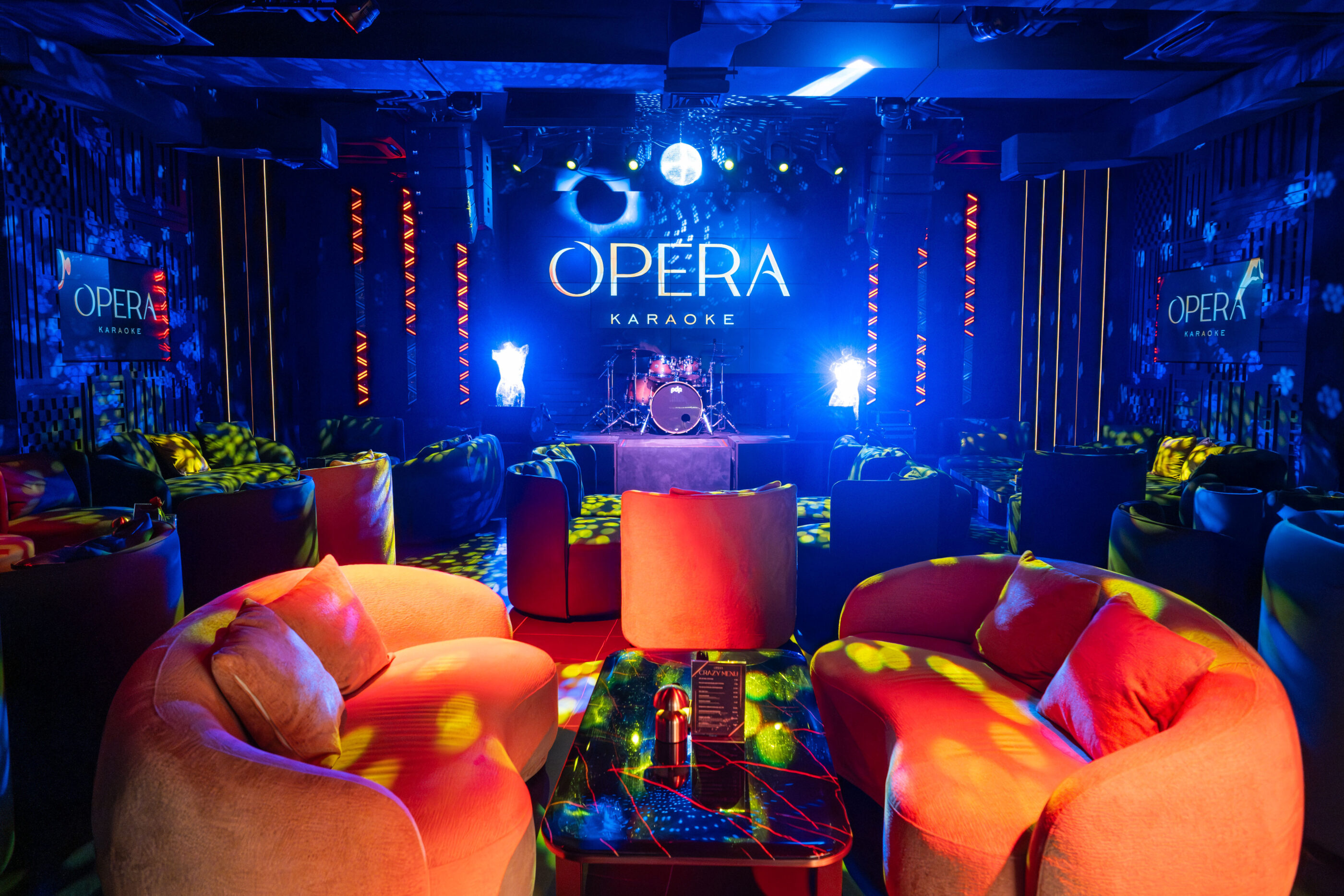
Challenge: The venue required consistent, professional vocal reproduction across rooms with significantly different dimensions, materials, and intended capacities — from intimate two-person booths to large group VIP suites. Cross-room bleed had to be eliminated entirely, and the system needed to be operable by non-technical staff during 10-hour nightly shifts.
Solution: Each room received a dedicated audio chain — speakers matched to room volume, independent amplification, individual DSP processing with feedback management, and acoustic treatment calibrated to that specific space. A centralized control system allowed staff to manage all rooms from a single interface while preserving full per-room independence. Inter-room isolation was engineered into the construction phase with double-stud walls, decoupled ceilings, and HVAC silencers.
Result: Zero cross-room audio bleed at typical operating levels, consistent vocal clarity across every room regardless of size, and a system that has operated reliably under nightly commercial duty without engineering intervention.
Common Mistakes in Karaoke Sound System Thailand Installations
After working on dozens of KTV installations across Thailand — from Phuket’s entertainment districts to Phuket’s tourist zones, and from Pattaya nightlife venues to Samui resort complexes — several recurring mistakes account for the majority of karaoke sound system Thailand problems. Owners considering an investment should specifically verify their contractor avoids each of these failure modes.
Using Consumer Audio Equipment
Many low-budget installations in Thailand use consumer-grade equipment — home theater receivers, hi-fi speakers, and prosumer microphones marketed at home karaoke users. These products are not designed for commercial duty cycles. They will fail within 18–24 months of operation, often during peak revenue hours. Professional KTV venues use commercial-grade equipment rated for 8+ hours of nightly operation in challenging conditions.
Wrong Speaker Placement Relative to Microphones
Speakers placed in line with microphones — especially behind the singer’s typical position — create chronic feedback problems that no amount of processing can fully solve. Professional installations place speakers ahead of the typical singing position, angled to minimize energy reaching the microphone’s rear pickup zone. This is basic acoustic engineering that requires understanding microphone polar patterns, but it is routinely ignored by installers who simply mount speakers wherever convenient.
Skipping Acoustic Analysis
Each karaoke room has unique acoustic properties that require measurement and tuning. Installing identical equipment in two different rooms will produce two different sound results unless the systems are individually calibrated. Professional contractors use measurement microphones and acoustic analyzers (Smaart, REW, Room EQ Wizard) to characterize each room and adjust equalization, delay, and limiter settings accordingly. Skipping this step — which most budget installations do — leaves performance to chance.
Underspecified Microphone Quantities
Karaoke groups frequently want to sing duets and trios. Rooms equipped with only one or two microphones force guests to share or wait, undermining the social experience. Professional designs include four to six microphone capacity per room, with sufficient mixer channels and processing to handle simultaneous use without compromising audio quality. A well-specified karaoke sound system Thailand venues invest in supports the way guests actually use the space.
Shared Amplification Across Rooms
To save cost, some installers use a single multi-channel amplifier feeding multiple rooms through speaker selectors. The result is cross-talk, level imbalance, and a single point of failure that takes down multiple revenue-generating rooms simultaneously when it fails. Each room should have dedicated amplification — the cost difference is small, the reliability difference is enormous.
No Provision for Future Service
Equipment racks crammed into inaccessible ceiling voids, cables run without labeling, and systems with no documentation create maintenance nightmares. Professional installations include accessible equipment rooms, fully documented signal flow, and remote monitoring so that issues can be diagnosed and often resolved without on-site visits.
Thailand-Specific Considerations for KTV Audio Installation
KTV projects in Thailand must account for environmental factors that international AV guides typically ignore. Year-round high humidity across Phuket, Krabi, Samui, and Phangan affects connector reliability, speaker driver longevity, and electronic component lifespan. Sealed equipment rooms with dehumidification extend system life significantly. In coastal locations — Phuket, Koh Samui, Koh Phangan, and Pattaya — salt air accelerates corrosion on exposed metal surfaces, requiring marine-grade hardware and protective enclosures.
Power quality is another factor. Thailand’s electrical grid experiences fluctuations and surges that damage sensitive audio electronics over time. Professional installations include line conditioning, surge protection, and uninterruptible power supplies for critical processors. These additions add 5–7% to project cost but prevent equipment failures that can cost ten times more in lost revenue and emergency repairs.
Wireless microphone licensing is a third Thailand-specific consideration. The NBTC regulates UHF spectrum allocation, and unlicensed wireless systems risk interference and fines. Professional installers handle frequency coordination and licensing as part of system delivery — ask explicitly whether your contractor includes this work or expects you to handle it independently.
Investment Range for a Karaoke Sound System Thailand Owners Can Trust
Karaoke audio investment varies dramatically by venue scale, room count, and ambition. As a working baseline for a professional karaoke sound system Thailand projects in Phuket, Samui, Phangan, Krabi, and Pattaya: a single professional KTV room with dedicated speakers, microphones, processing, amplification, acoustic treatment, and feedback management typically falls in the THB 180,000–350,000 range turnkey, depending on equipment tier. Larger VIP rooms with line arrays, premium microphone counts, and enhanced acoustic treatment can reach THB 500,000–800,000. Multi-room venues benefit from shared infrastructure (control systems, distribution, documentation) and typically achieve a per-room cost reduction of 15–25% at scale.
The amateur-versus-professional cost difference is typically 30–50% on the front end — and pays back many times over through customer retention, premium room pricing, and reduced maintenance costs over the system’s lifetime. Owners who quote-shop on price alone almost universally end up rebuilding within three years; owners who specify properly the first time operate the same system for a decade.
Maintenance and Long-Term Operation in Thai Climate Conditions
A professional karaoke sound system Thailand installation is designed to operate with minimal intervention — but not zero intervention. Microphone capsules degrade with use and should be inspected quarterly. Speaker drivers can develop voice-coil issues from sustained heat and humidity exposure. DSP firmware receives security and feature updates from manufacturers. Acoustic treatment accumulates dust that affects absorption performance over time.
Professional service contracts typically include quarterly preventive visits, remote system monitoring, firmware management, and priority response for failures during operating hours. The annual cost is usually 3–5% of installed equipment value — modest insurance against the revenue impact of a system failure during peak service.
Why Professional Installation Matters for KTV Venues in Thailand
Karaoke is fundamentally a participatory entertainment format. Guests pay for the experience of singing, not for the right to sit in a room. When the audio system makes that experience frustrating — feedback, muddy mix, uneven volume, dropped microphones — guests do not blame the system. They blame the venue, and they do not return. This makes audio quality directly tied to repeat business in ways that other commercial venues do not face.
A well-designed karaoke sound system Thailand operators choose protects this revenue stream by delivering audio that flatters average singers, supports group dynamics, and operates reliably through long sessions without staff intervention. Beyond the audio itself, professional installation includes proper documentation, staff training, and ongoing technical support. KTV venues operate every night with non-engineer staff. Systems must be designed for that reality — with controllers that staff can operate confidently, fault detection that alerts management before problems become guest-visible, and remote support capabilities that allow issues to be diagnosed and often resolved without on-site visits.
When evaluating contractors, ask specific questions about acoustic analysis methodology, equipment specifications, feedback management approach, frequency licensing, and post-installation support. Vague answers indicate inexperience with the unique demands of KTV audio. Specific, technical answers — grounded in measurement and engineering rather than brand names alone — indicate the kind of professional approach that will deliver a karaoke sound system Thailand venues can trust for the next decade.
Karaoke Sound System Projects Across Thailand
Clubtek delivers KTV audio installations across every major Thai market segment. Phuket remains Clubtek’s primary KTV market, where high-end karaoke complexes in Patong, Cherngtalay, and Bangtao entertainment zones all require purpose-engineered audio. Phuket sees a mix of tourist-driven karaoke bars in Patong and resort-attached KTV rooms in Cherngtalay, Bangtao, and Kata. Pattaya’s entertainment districts support both walk-in karaoke venues and private hotel KTV facilities. Koh Samui and Koh Phangan primarily serve resort and villa applications where multi-room private karaoke is part of the luxury hospitality offering.
Each market carries different operational realities — Phuket island venues prioritize humidity, salt-air, and power-quality engineering; Phuket, Krabi, Samui, and Phangan demand humidity, salt-air, and power-quality engineering; resort venues require integration with broader hotel AV infrastructure. A karaoke sound system Thailand venue operators rely on must be specified for the specific city and venue context, not generically for “Thailand.”
Frequently Asked Questions: Karaoke Sound System Thailand
How much does a professional karaoke sound system Thailand venues install typically cost?
A single professional karaoke room in Phuket with dedicated speakers, microphones, processing, amplification, acoustic treatment, and feedback management typically costs THB 180,000–350,000 turnkey. Larger VIP rooms reach THB 500,000–800,000. Multi-room venues benefit from shared infrastructure and typically achieve 15–25% per-room cost reduction at scale.
Where does Clubtek deliver karaoke sound system installations in Thailand?
Clubtek delivers KTV audio installations across Phuket, Koh Samui, Koh Phangan, Krabi, and Pattaya. Phuket and Krabi account for the majority of commercial KTV projects, with Samui and Phangan serving primarily resort and luxury villa applications.
What is the difference between a commercial KTV system and a home karaoke machine?
Commercial KTV systems are engineered for 8+ hour nightly duty cycles with components specified for that load: licensed UHF wireless microphones, amplifiers with 2:1 headroom, adaptive feedback management, and engineered room isolation. Home systems are built for 2–4 hour occasional use. A home system installed in a commercial venue typically fails within 18–24 months.
How many microphones does each karaoke room need?
Professional KTV designs include four to six microphone capacity per room. Karaoke groups frequently sing duets and trios, and rooms equipped with only one or two microphones force guests to share or wait, undermining the social experience.
Can acoustic treatment be retrofitted into an existing KTV room?
Yes, but at higher cost and with compromises. Surface-mounted absorption panels, ceiling diffusion, and floor treatment can be added without major construction. However, inter-room isolation typically cannot be added retroactively without rebuilding walls and ceilings — which is why isolation must be designed into the construction phase.
What is the typical lifespan of a professional karaoke sound system Thailand venues install?
Commercial-tier KTV equipment reliably delivers 7–10 years of nightly operation when properly maintained. Microphones may need capsule replacement at 3–5 years depending on use intensity. Speakers and amplifiers operating within their thermal and headroom envelopes routinely exceed 10 years. Consumer-grade equipment installed in commercial venues typically fails within 24 months.
Do I need a license to use wireless microphones in a karaoke venue in Thailand?
Yes. Wireless microphone systems operating on UHF frequencies in Thailand are regulated by the NBTC and require licensing. Professional installers handle frequency coordination and licensing as part of system delivery. Unlicensed systems risk interference, equipment seizure, and fines.
Ready for a Professional Karaoke Sound System in Phuket or the Islands?
At Clubtek, our karaoke projects integrate with our broader expertise in commercial AV — from intimate restaurants to large nightclub installations. (See: nightclub sound system pricing breakdown.) The principles that make KTV audio work also support our work in restaurants, bars, beach clubs, and conference spaces across the country. If you are planning a new venue or upgrading an existing one, our engineering team can help design a karaoke sound system Thailand owners can rely on, tailored to your specific space, capacity, and operational requirements.
We provide free site surveys, detailed equipment specifications, acoustic analysis, NBTC frequency coordination, installation, staff training, and ongoing technical support across Phuket, Koh Samui, Koh Phangan, Krabi, and Pattaya.
Contact Clubtek Thailand for a professional KTV consultation:
About the author: Nick Kolpakov is the CEO of Clubtek, with over 15 years of experience designing and installing professional audio systems for hospitality venues across Thailand.
For deeper context on speaker technology in larger KTV rooms with line array setups, see our line array vs point source comparison guide. For sibling venue applications, see our restaurant sound system design guide and beach club sound engineering guide.